By Stephanie McNulty and Jared Abbott
As a new generation of leftist mayors emerges in major cities around the United States and the world, we are experiencing a renewed call for participatory politics at the local level. New York’s Mayor Zohran Mamdani has created the city’s first Office of Mass Engagement to transform the ways that New Yorkers engage with their municipal government. Boston’s Mayor Michelle Wu just announced the result of the city’s participatory budgeting process that dedicated $2.2 million to projects aimed at empowering immigrants and youth as well as promoting housing stability.
Burlington’s Progressive Mayor Emma Mulvaney-Stanak revamped co-governance planning assemblies last year to help revitalize civic culture in her city. Democratic socialist mayors have promised to empower and engage ordinary citizens in unprecedented ways from Barcelona and Copenhagen to Jackson, Mississippi, and Bogota, Colombia.
This new generation of leaders is reminiscent of politicians, activists, and academics calling for participatory democracy in the 1960s and 1970s, by groups like the Students for a Democratic Society and the Student Non-Violent Coordinating Committee (SNCC). Manifestos like the Port Huron Statement and seminal texts such as Paulo Freire’s Pedagogy of the Oppressed called for more participatory democracy based on collective decision-making and community engagement. Political theorists like Hannah Arendt and Carol Patemen advocated for more participatory engagement to cure the democratic malaise felt by many during this era. The renewed call for participatory politics is also linked to a decline in trust and support for democracy and our elected leaders.
The current calls for new forms of citizen engagement are connected to a larger, global expansion of participatory democracy in local politics that has been gaining steam for over thirty years. As more and more countries began to democratize in the 1970s and 1980s, it became clear to many that if democracy was going to be worth its salt, it would need to go beyond elections alone. Countries in Latin America, Asia, and Africa experimented with news ways to engage citizens in politics in a more regular and sustained way. Citizen councils, participatory planning, citizen’s assemblies, and participatory budgeting now exist in hundreds of thousands of cities around the world—in both democratic and non-democratic contexts. These international experiences provide many lessons for current mayors seeking to expand civic engagement.
We have been closely following one of the oldest and most ambitious of these for more than twenty years in Peru. When autocrat Alberto Fujimori left office in 2000, Peruvian national reformers created a range of participatory institutions in every local and state government around the country. The hope was that doing so would deepen the country’s fragile democracy, improve transparency, and generate greater accountability among local elected officials who are often mired in corruption. In 2003, for example, they passed the world’s first national participatory budgeting (PB) law, which sets up consultative budget-making in all subnational governments. These efforts were led by participatory democrats who themselves had been mayors in the years prior, working with technocratic allies in the national Ministry of Economics and Finance.
It may surprise many that Peru has such an extensive participatory ecosystem. Peru’s national politics are known for their instability, with nine presidents since 2017 and one attempted coup. Political gridlock and corruption dominate the headlines, and Peruvians have some of the lowest rates of support for democracy in Latin America. It is a very unlikely place for democratic innovation.
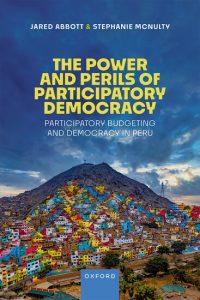 Our new book, based on twenty years of data collection, explores the ways that these institutions have changed their communities over time. The Power and Peril of Participatory Democracy: Participatory Budgeting and Democracy in Peru employs several unique databases and original surveys, as well as twenty years of interview data, to provide us a nuanced understanding of how participatory democracy is changing Peru.
Because of the political instability and anti-democratic nature of national politics in Peru, we did not expect to see many positive changes when we started the study. We were wrong. Peruvian participatory democracy has led to interesting changes at the community level.
Our research focused on one particular institution in Peru’s municipalities: participatory budgeting (PB). Peruvian local governments must dedicate a portion of their annual infrastructure budgets to PB, and the process—outlined in instructions published by the Ministry of Economy and Finance—takes place in more than 1,900 cities and towns every year.
Four specific sets of findings stand out.
First, participatory institutions improve the quality of democracy. Our work documents changes in accountability, participation, and government responsiveness—all key indicators of how well democracy is working in a given country. We conducted a nationally-representative survey and found that Peruvians attend PB meetings in significant and sustained numbers, even after 20 years. Our results indicated that eight percent of the adult Peruvian population (about 2.5 million people) have attended a PB meeting at some point. To put that in some context, researchers in the United States have estimated that the US and Canada combined have seen roughly 740,000 people participate in PB over the past decade or so—well under half a percent of the US adult population.
Further, when people participate in PB meetings, they are more likely to undertake activities that hold officials accountable, such as petitioning an official or attending a town hall meeting. This is illustrated by a woman McNulty met in 2017 who had attended PB meetings and started to track her local government’s spending. She would check to see that the projects that were approved actually received funding. She occasionally uncovered some attempts at corruption and would report that to oversight boards.
In terms of responsiveness, our work also documents an increase in government spending that benefits the poor when more funds are dedicated to PB in a community. Our book tests this relationship statistically, and presents data that can support this positive finding. Our interviews also tell a similar story. For example, one municipal official told McNulty that “PB works very well here. People are happy. PB … helps us see what the needs are.”
Second, participatory institutions can make a material difference in people’s quality of life. Evidence we present in the book suggests that when PB is carried out over an extended period of time, it leads to higher levels of income and improvements in overall human development (in terms of income, education, and health) in communities. Here again, a local activist’s experience is the best illustration of this point. In a 2017 interview, a grassroots organizer in the outskirts of Lima told McNulty that he got involved in local activism in the late 1980s due to the extensive needs in his shantytown. He and his neighbors needed access to water, sewage, electricity, walls to hold the desert soil, and stairs and roads to allow people to travel safely up the hills where they lived. The neighbors organized themselves and worked with the municipal government to get streets, sidewalks, tiles, and stairs—often through PB. He told McNulty that “we almost have it all now, the entire list. Sometimes we have to be creative. If our projects aren’t funded through PB we go to the national government and petition.”
Before this study, PB’s effects on well-being had been documented primarily in Brazil, where scholars such as Sónia Gonçalves, Michael Touchton and Brian Wampler have been able to compare communities with and without PB to determine how it has changed individual well-being. We demonstrate similar impacts in a country with far fewer enabling conditions—like a strong civil society sector and politicians who are supportive of citizen engagement—that scholars of PB have identified as critical to program success. This means that the range of contexts in which PB can play a positive role in fostering citizen participation, improving democracy, and enhancing well-being is potentially much greater than scholars have previously assumed.
Third, participatory institutions are a promising vehicle for engaging and strengthening civil society. We find that PB participation has a positive impact on civic participation, indicating that the fabric of associational life has been transformed (albeit modestly) thanks to the introduction of PB. PB participation also has several spillover effects. When a person participates in PB, for example, they are more likely to participate in civic and political life. In turn, communities with more organized civil society sectors tend to dedicate more resources to the PB process. These higher investments strengthen the civil society sector in terms of intensity and density, creating a positive feedback loop between PB and civil society.
Fourth, participatory institutions can improve citizens’ perceptions of local government. For example, we show that when citizens know that PB has led to tangible improvements in their community—i.e., improvements in well-being—they feel more satisfied with their local government compared to otherwise similar members of their community. When participatory institutions improve material outcomes that citizens hold dear, citizens are more likely to credit local governments with delivering improved outcomes—a sentiment they convey by registering higher levels of satisfaction with local government.
Again, it is surprising to see these positive changes in a country like Peru. Peru is what we would call a “least likely case,” meaning that many aspects of Peru’s context and politics make it very hard for participatory democracy to effect change. In addition to a national political environment that is getting less and not more democratic, characterized by political instability and corruption, Peru does not have many of the common prerequisites for successful participatory institutions. A large set of studies shows that to be successful and effective, participatory governance needs committed local leaders, an active civil society sector, and sufficient resources to back up the processes. It tends to work best when it emerges from organic municipal co-governance, and not from a legal mandate set by national government officials (like the PB Law in Peru). Yet, even in this very difficult case, positive changes are emerging.
The reason behind these positive changes are intuitive. By bringing people together year after year, people learn more about governments and government officials learn more about their communities. Simple information-sharing plays a large role in explaining why participatory institutions can improve democracy and governance. In a country like Peru, the legal mandate ensures that this happens year after year. There has been a lot of discussion about the effectiveness of top-down legal frameworks and citizen participation efforts, but we now believe that they do work, especially in the absence of committed government officials over time.
Our findings show the power of participatory democracy in a difficult context where most of the literature would not have anticipated even modest positive effects. We would expect even more robust impacts in nations and communities that have stronger commitments to participatory institutions, and more favorable structural conditions for success—stronger state capacity and civil society, and less severe political instability—than Peru. This should give hope to people working to improve local democracy through participatory institutions around the world. If we are seeing these changes in Peru, then dedicated officials who are committed to participatory democracy can surely create effective experiences that truly transform the nature of democracy in their cities.
Of course, participatory institutions are no panacea and there are clear limits to the kind of changes we can expect to observe. We do not want to overstate the effects of PB in Peru. For example, the power of participatory institutions lies mostly at the local level; these changes simply do not scale up to national-level improvements in the functioning of democracy.
Furthermore, like many other scholars, we find that these spaces tend to attract disproportionately high rates of participation among men, the college-educated, and individuals with extensive previous civic engagement, while doing little to increase rates of civic participation among women, non-whites, and the poor. This is a serious problem that all advocates of participatory democracy should keep in mind.
Another issue in Peru is that the quality of PB meetings is quite low, at least in many places. When observing meetings around Lima in 2017, McNulty documented that meetings are dominated by men and particularly male municipal officials. This is a clear indicator that meetings are not particularly deliberative or participatory. An expert on decentralization and PB made this point when noting that PB workshops are often “a formality and merely expositive.” Poor public meeting quality is one reason that the National Civic League’s “Better Public Meetings” Initiative is so important. People do get frustrated when they attend PB meetings that are actually not that participatory.
What lessons does this twenty-five year experience with participatory democracy have to offer this new generation of leftist mayors who are trying to create new ways to engage their constituents in governance?
One important lesson is the need to connect participatory innovations to each other and the larger government structure to create efficiencies. Most cities have several spaces for citizen engagement and agencies that fund social programs. The key to transforming a city into a hub of civic engagement is to make sure that all of the spaces and agencies are coordinating and collaborating.
Second, well-funded efforts are essential. Over two decades of research shows that well-funded participatory institutions will have stronger effects on reducing poverty and deepening democracy.
Third, officials and local activists need to conduct active outreach and reduce barriers to attending meetings. Several studies of participatory democracy, which involves many meetings, have shown that aggressive marketing and outreach campaigns will increase rates of participation. Making meetings easy to attend— with easy-to-reach locations, childcare, accessible buildings, and low transportation costs— will also improve attendance. Translated materials and meetings will also help. Organizers should also publicize the things that participatory institutions do well, or else the institutions’ impact on citizens’ attitudes about the functioning of democracy will go largely unrealized.
Relatedly, it is important to create opportunities for deliberation and active participation during meetings. There are many resources that provide tips for running meetings more equitably (see here and here, as examples).
It is also important to create participatory processes that are explicitly redistributive in nature. For example, in PB there are proposals to evaluate. When evaluating, there is usually a rubric to follow. The rubric should include points for projects that target low-income neighborhoods or projects that explicitly adopt equity goals. This is illustrated well in Belo Horizonte, Brazil, where the municipal government created a quality of life index to guide evaluator decisions to prioritize low-income areas when funding projects.
The failure to create robust, well-designed, and inclusive participatory institutions can lead to disillusioned residents and co-opted decision-making spaces. We all know how frustrating it is to spend precious time in meetings and walk away with little to show for it. On the other hand, if people can easily attend a well-run meeting in a well-designed participatory process, they leave feeling empowered and better informed about government.
Our work strongly supports the idea that it is better to invite people into public spaces and involve them in political decisions than to make these decisions without citizen engagement. When done over time, communities benefit from these choices. When decisions are made with careful attention to certain design principles and with explicit goals to improve the well-being of residents who are struggling to make ends meet, they can truly transform communities.
Stephanie McNulty is the Honorable John C. and Kathering Kunkel Professor of Government at Franklin and Marshall College and Jared Abbott is Assistant Professor of Political Science at Cal State Los Angeles.