By Lisa Hager, David Gilbertson, and Paul Briseno
We’ve all heard the saying, “Don’t fix what’s not broken.” While often sound advice, just because something isn’t broken doesn’t mean it’s not in need of some updating or improvement. Like home renovations, city charters should be reviewed and updated before they break. Unlike home improvement projects though, the average person may not understand the reason behind revisiting and revising a city charter that isn’t in drastic need of fixing. While home renovations rarely require the approval of neighbors, a revised city charter must be passed by a majority of citizens. It can then be challenging to overcome that phrase we’ve heard so often.
Answering the question of why the city’s charter needed to be reviewed and revised was just one challenge we encountered in Brookings, South Dakota, when we started this process in the Summer of 2024. This question continued to arise as we progressed, especially as we began our public information campaign prior to the April 2025 municipal election that asked voters whether to adopt the revised charter. Ultimately, voters overwhelmingly approved of the revised charter by a roughly two-to-one margin. Our efforts to educate voters paid off, but we learned some lessons along the way that could help other municipalities when updating their charter, especially if it closely follows the National Civic League’s Model City Charter.
The Brookings City Charter: The History and Revision Process
In November 2002, Brookings citizens voted to become a home rule community to ensure that its government could be more responsive to community needs rather than operating within the confines of one-size-fits-all state laws. In the process, voters also adopted a revised city charter that outlined the city government’s structure, powers, and responsibilities. The Brookings City Charter closely followed the National Civic League’s Model City Charter (9th edition). In keeping with the city’s recent transition from the commission style of government to the council-manager form in 1999, the charter also included transition language relating to the election schedule of the mayor and city councilors and the adoption of temporary ordinances relating to the change in the form of government.
In the years that followed, the Brookings City Charter was reviewed twice and amended once. In 2006, the review led to an amendment that prohibited discrimination during the appointment or removal of city officials, but in 2010-2011, no revisions were deemed necessary. In 2024, city staff and the city council realized that the intended 2020 review had slipped through the cracks due to the COVID-19 pandemic. Even a cursory reading of the charter indicated a need for it to be reviewed and amended, and the city had also experienced considerable growth. Since 2000, Brookings has added roughly 5,500 residents and experienced increased enrollments at South Dakota State University (SDSU) and rapid economic development. Consequently, it was important to form a charter review commission and get back on track in following the Model City Charter’s recommendation of reviewing charters every 10 years.
The Brookings Charter Review Commission was appointed by the Brookings City Council in June 2024. Nominations were made by the mayor, city council, and city staff with council selecting the final members based on their qualifications, experience, and commitment to public service. Members included community leaders, academics, and former elected officials. At the first meeting in June 2024, the chair and vice chair were selected to lead the charter revision process and public outreach efforts prior to the election. We (retired South Dakota Supreme Court Chief Justice David Gilbertson and Associate Professor of Political Science at SDSU Lisa Hager) were selected due to our familiarity with legal documents, experience speaking with the media, and reputations of being politically neutral.
With support from Derek Okubo, the National Civic League’s Director of Civic Assistance, and assistance from city staff, the commission worked through the charter line by line. Along with suggestions submitted by city council and city staff, we proposed multiple revisions during our public meetings in Fall 2024. We received recommendations from the public that spanned the political spectrum, ranging from concerns over the power of local government and the city manager to whether the charter adequately protected citizens from discrimination and encouraged public engagement and participation.
By December 2024, we had a marked-up charter ready to present to the city council. We (David and Lisa) presented the commission’s recommended revisions to the council in January 2025. The council accepted the revisions and added the proposed changes to the April 2025 municipal election. Throughout February and March 2025, we worked with city staff on a public information campaign. We presented to a variety of civic organizations (e.g., Kiwanis) and at a forum hosted by the Brookings Chamber of Commerce.
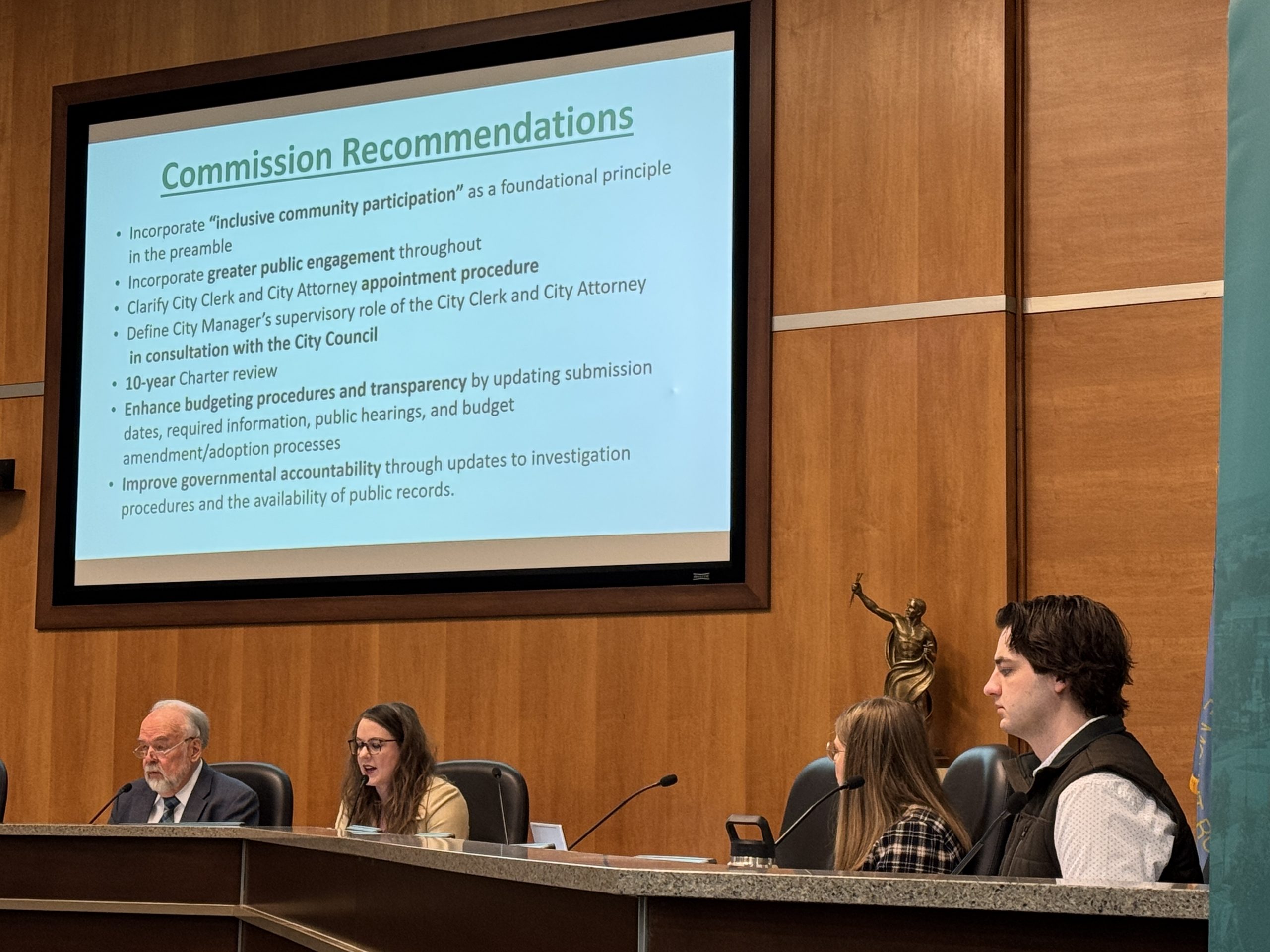
Council Member Hager and Chief Justice Gilbertson presenting and answering audience questions about the Charter review at the City Charter Forum, hosted by the Brookings Area Chamber of Commerce, on Feb. 22, 2025
Ultimately, our work paid off with an overwhelming 72 percent of voters approving of the revised charter. Although 1,548 ballots were cast in favor of the revised charter, there were 610 voters who preferred the existing charter. This may sound surprising given the charter closely followed the Model City Charter and there was a need to clean-up transition language from the city’s move to a manager-council form of government. However, these 610 votes likely represent some of the challenges we faced and views regarding the sections of the charter that received the most attention and revision. Our discussion of these should help other municipalities overcome similar issues and have a successful review and revision process.
Proposed Revisions to the Brookings City Charter
To understand the challenges we faced, it is beneficial to provide an overview of the proposed revisions and to identify which ones garnered the most attention. As expected, revisions that removed transition language from the city’s move to the council-manager form of government and provided for more modern terminology (e.g., “handicap” to “disability”), received little attention or questions from citizens. This was also true for adjustments relating to the preamble, powers of the city, and charter amendment process. In the preamble, we took the National Civic League’s advice and responded to public comment by emphasizing the importance of public engagement and citizen participation. Under Article I – Powers of the City, we adopted the Model Charter’s language regarding intergovernmental relations because it was more succinct and a detailed discussion of state and federal law constraining City power was not needed given Sec 1.01 already establishing this.
The revisions that elicited the most attention from citizens were those relating to the city council, city manager, and city attorney. While not every revision sparked controversy, at least one did for each official. The revisions in Article III governing the city manager received few responses from citizens; however, revised duties contained in Article II on city council and Article IV relating to the city attorney garnered significant interest.
Article III made some changes regarding the hiring and removal of the city manager, primarily establishing a residency requirement and mentioning the possibility of a vacancy due to resignation. Other changes included updating the city manager’s responsibilities, namely relating to creating ten-year, instead of five-year, capital improvement and financial plans, ensuring that council is regularly advised on both, and facilitating community partnerships to support long-term goals.
One of the city manager’s duties in Article III is overseeing city operations and personnel. However, the city manager’s relationship with the clerk and city attorney are called out separately in Article II on city council and Article IV on Departments, Offices and Agencies. The amendments relating to the city manager’s role in appointing and supervising the city attorney and city clerk elicited some negative attention from the public.
The original charter specified that the city council would appoint the city attorney and city clerk, but it was unclear who supervised both. While it could be inferred that it should be the council, it could also be argued to be the city manager as the “personnel director,” especially since the council is a part-time legislative body. This lack of clarity led city council and city staff to recommend the charter reflect current practice on the supervision of both positions and the appointment process. For both positions, the city manager vets potential candidates, formulates a list of finalists, and makes a recommendation to city council. Similarly, the city manager makes a recommendation to council regarding the reappointment of individuals holding both positions. The city manager’s viewpoint is valuable because he/she interacts with the city attorney and city clerk on a regular, if not daily, basis, which contrasts with the council’s typical weekly contact. This reality has led to the city manager serving as the daily supervisor to both positions but doing so in consultation with the city council.
These proposed changes, which are options from the Model City Charter, elicited concerns from citizens who felt that the city manager was gaining control over two quasi-independent positions whose purpose is to serve the city and answer to city council. We expected this reaction; the city attorney was due to retire in June 2025 and Brookings is not immune to the mixed reactions that city managers receive from citizens. While citizens often appreciate their expertise, some are suspicious of an administrator who exercises substantial power without electoral accountability (the caveat being that many forget that city managers are appointed and reappointed by a city’s council, so abuse of power is less of a concern). Regardless, the attention these revisions received meant that other amendments in the section on city council were overlooked.
While some changes were efforts to avoid regular updates in the future, such as removing the specific salary in the compensation section, others quelled some of the concerns citizens had. Specifically, we updated investigation procedures and added language to ensure the charter is reviewed every 10 years unless needed sooner. Rather than the city council conducting investigations, the revisions specified hiring a third party. The investigation’s findings would then be reported to the council. This eliminated the conflict of interest in the existing charter where council was both investigator and judge. Additionally, this addressed what citizens were concerned about: abuse of power or wrongdoing.
Strategies for Passing the Revised Brookings City Charter and Lessons Learned
Before publicly releasing the revised city charter, we anticipated that some changes would be controversial, but we knew that most citizens would not understand what a charter is and why it is important to review it. Knowing these realities were beneficial as we determined the phrasing of each revision and crafted our public information campaign. Although we were forward-thinking, we did not anticipate every roadblock. Still, the revised charter proposals passed, and our strategies and lessons learned can help other municipalities.
As our first line of defense, we thought carefully about the wording of provisions, especially the ones we knew would be controversial given our knowledge of local politics. Since we expected revisions relating to the city manager’s role in appointing and managing the city clerk and city attorney would be controversial, we tried to use language citizens would understand. For both positions, our edits stated: “The City Manager shall recommend the appointment of a City Clerk/City Attorney, subject to advice and confirmation by the City Council. The Clerk/City Attorney will be supervised by the City Manager in consultation with the City Council” (see Article II, Sec. 2.08 and Article IV, Sec. 4.02).
We thought a couple of key words and phrases would assuage citizen concerns, specifically “recommend,” “advice and consent,” and “consultation.” “Advice and consent” would liken the process to the nomination and confirmation process used at the federal level in which the city manager and city council would be similar to the president and Senate, respectively. Although not a perfect analogy, we believed citizens would grasp the concept that the council would advise the city manager on what is needed in a city clerk and city attorney so a proper recommendation could be made. Furthermore, we thought the use of “recommend” would ensure the city manager was doing just that, with the council being the ultimate decision maker. By mentioning that the city manager would supervise both positions in “consultation” with the council, we again believed that it would be clear that the council exercised final authority over both positions.
Although our strategy was to use accessible language, we didn’t think too many citizens would read the revised charter. However, as questions arose, we thought some would, or at the very least, we could point to the language that would assuage any concerns during our public information campaign. What we didn’t anticipate is how few questions were raised during public presentations or on social media and how few citizens reached out. To address our lesson learned from this, it is beneficial to discuss our public information campaign.
We had a three-pronged public information campaign: detailed materials posted on the city website, social media content, and public presentations. The City of Brookings had a dedicated webpage for the charter review that included information about the members, a frequently asked questions (FAQ) document, a summary of the revisions, and both clean and marked-up versions of the charter. The FAQ sheet explained the history of Brookings becoming a home rule community with a city charter, the charter revision process, a brief overview of the proposed changes, and next steps including the election and the charter’s amendment process. The more detailed summary document used accessible language to discuss the major revisions. For the controversial revisions, we ensured that the key words and phrases from the charter were used when discussing how the city clerk and city attorney would be selected and supervised by the city manager. For example, the Article II changes regarding the city clerk said: “Adjusted the clerk’s appointment process to involve recommendation by the City Manager and confirmation by the Council. Added supervision by City Manager in consultation with City Council” (emphasis added).
These efforts to use consistent language to alleviate concerns regarding controversial revisions all hinged on whether citizens knew about these documents and read them. Informing citizens about the Charter Review Commission webpage was one focus of the social media campaign. Much of the content focused on releasing information found in the FAQ sheet. Some of the commissioners also made videos addressing these topics that were featured on the city’s social media accounts. While this is an effective way to reach citizens, not everyone has social media or if they do, follows the city’s accounts. Consequently, we tried to do as many public presentations as possible.
Our first presentation was after a forum hosted by the Brookings Area Chamber of Commerce with state legislators in February 2025. For each presentation, the commission chair (David) explained the concept of home rule, what city charters do, why the Brookings City Charter needs to be reviewed, and who served on the commission. As the vice chair, I (Lisa) followed by explaining the proposed revisions to the charter, highlighting each change and why the commission suggested it. More importantly, I emphasized the key words and phrases we used in the controversial provisions. We finished by explaining that the revised charter would be a ballot item on the April municipal election. David also stressed that voting against the proposed revisions would not eliminate the city charter, it simply meant the existing version would remain in effect. This was another opportunity to highlight how the current charter was outdated and that the changes were minor in scope. During a Q&A period, we mentioned the severability clause and the amendment process.
Both provisions could be worked into answers to questions about voting against the proposed revisions and questions about what would happen if the revisions are approved and prove unworkable. With citizens not having many questions, we were able to spark conversation with both provisions. Consequently, we would recommend other cities have specific topics that can be highlighted during Q&A. Section 10.0.6 lays out severability by stipulating that if any provision is “held invalid, the other provisions of the Charter shall not be affected thereby.” While severability may not be a term that citizens are familiar with, discussing this helped us show that the charter is not eliminated if any one provision is found invalid by the courts or is amended. This then allowed us to explain the amendment process in Section 9.
Amendments to the charter can be proposed in four ways by:
- state law via the initiative or referendum process;
- an ordinance of city council, notwithstanding sections relating to city council’s powers, duties, and elections;
- a charter commission report via an ordinance; or
- a committee of 15 voters of the city.
After the city clerk receives the proposed amendment(s), an election will be held within 60 to 120 days. If a regularly scheduled election will not take place during that window, a special election must be held. Explaining this process to citizens, especially that voters themselves can propose a charter amendment, helped us emphasize how voting for the proposed revisions did not mean they could not be changed later. Additionally, the city council plans to follow the National Civic League’s recommendation to review the charter every 10 years, so it can be changed if it becomes unworkable.
This approach to our presentations seemed to work well as we met with numerous groups, such as the Rotary and Kiwanis clubs, across Brookings. That it did work well is suggested by the results of the April 2025 election. The charter revisions were overwhelmingly adopted by the 2,158 voters who cast ballots with 1,548 (72 percent) voting “yes” and 610 (28) voting “no.” While we anticipated some no votes, given citizen skepticism relating to the council-manager form of government and the tendency of voters to vote no on items they are unfamiliar with, we were successful at getting the word out about the election, the proposed changes, and why they should be adopted by voters.
Being forward-thinking was especially key in the drafting process by ensuring accessible language was used in each revision. This also helped avoid the charter getting politicized by either party. Ensuring citizens knew about the charter revisions through a public information campaign was especially important in getting them to the polls and having them vote yes. Having a dedicated city webpage, engaging social media content, and giving public presentations proved to be an effective approach that we would recommend for other cities. In fact, since the election, there has been no talk of any amendments being needed. Overall, while “don’t fix what’s not broken” is often sound advice, it is important to review and revise city charters before they are broken; and, in our case of Brookings, South Dakota, we were able to develop an approach that could be a blueprint for other cities, especially those with charters that follow the Model City Charter.
Lisa Hager is an Associate Professor of Political Science at South Dakota State University and a member of the Brookings City Council. David Gilbertson is a former South Dakota Supreme Court Chief Justice, and Paul Briseno is Brookings City Manager.