By Nick Vlahos
Research on democratic backsliding in the United States points to the rise of radical populism, attacks on electoral integrity, partisan stacking of judicial bodies, the decline in the rights and freedoms of minorities, the erosion of institutional checks and balances, the expansion of executive authority, and the broader weakening of democratic norms within central state institutions. The fate of democracy appears to be in the balance, but to most observers, it hinges almost entirely on what occurs within national political institutions.
Two things can be true at the same time. Arguably, this perspective risks overlooking a crucial dimension of democratic life, namely the local institutions and civic networks that sustain democratic practice outside the central state. National political discourse often conveys the impression that democratic institutions are collapsing everywhere. Yet in communities across the United States, local governments, civic organizations, and residents continue to experiment with new forms of participation and governance. These efforts rarely attract national attention, but they play a vital role in sustaining democratic norms.
Over the past several years, at the Center for Democracy Innovation at the National Civic League, I have had the opportunity to observe local democratic life more closely than most people do, across multiple communities. As a researcher and practitioner working on civic infrastructure across the United States, I have conducted well over one hundred interviews with residents, elected officials, public servants, and community leaders. I have facilitated public forums in cities across politically diverse regions, surveyed hundreds of residents about their civic experiences, and supported the piloting of democratic interventions and innovations in decision-making bodies. These engagements offer a rare window into American democracy and reveal patterns of institutional adaptation that are often invisible in national political analysis.
For this article, my central aim isn’t to deny the stark reality portrayed in national discourses of American democracy. It is to showcase an alternative perspective that democratic resilience depends not only on what happens in federal-level institutions but also on the civic infrastructure embedded within local communities. Across cities and municipalities, networks of local governments, civic organizations, and community leaders sustain everyday practices of participation, deliberation, and accountability. In this sense, local and regional civic infrastructure can function as a system of institutional learning. When communities identify participation challenges, test new engagement practices, and adapt governance structures over time, they build resilience and capacity to respond to change.
Revisiting the Center–Periphery Divide
Understanding the role of civic infrastructure in democratic resilience can be usefully revisited through a classic concept in political sociology: the center–periphery divide. In their influential work on political cleavages and party systems, scholars such as Stein Rokkan and Seymour Martin Lipset described how modern states developed through tensions between central authorities and peripheral regions. Historically, these conflicts revolved around cultural autonomy, linguistic identity, and regional economic interests. The center sought to consolidate administrative and political authority, while peripheral regions resisted incorporation into centralized political systems.
This framework has been widely used to explain patterns of state formation and regional political mobilization. Yet it can also illuminate the resilience of democratic systems. In contemporary democracies facing populist pressures, the relationship between center and periphery may extend beyond merely resisting state formation; peripheral institutions such as local governments, civic organizations, and community networks may play a critical role in sustaining democratic norms when national institutions become strained.
To see this more clearly, it is necessary to broaden the concept of the political toward a civic periphery. Rather than referring only to geographically distant regions, the periphery can be understood as the network of institutions and actors operating outside the central state. Of course, the term ‘periphery’ is nuanced in that on the one hand it can mean geographies and relationships that are peripheral and marginalized. It also seemingly denotes something lacking connectivity being so amorphous. On the other hand, what if a civic periphery also encompasses processes, struggles and mobilization that take place by leveraging dynamic relationships and networks across spaces and places. What if civic goals and visions are more effectively or innovatively applied and adapted because of where they are situated in many diverse places and contexts that amount to more than just a sum of peripheral parts and actions?
Viewed this way, the civic periphery can function not simply as sites of ‘participation’ but as a practical safeguard against democratic erosion through the dispersion of resistance. These processes, relationships, partnerships, and institutions generate civic opportunity through which residents encounter public life, develop civic skills, and participate in collective decision-making. In effect, these decentralized networks resemble what scholars describe as polycentric governance. Through neighborhood associations, nonprofit organizations, participatory forums, and public meetings, communities create pathways through which citizens engage with democratic institutions and with one another.
Civic Infrastructure as Institutional Practice
Public meetings and participatory forums play a central role in civic infrastructure. City council meetings, school board discussions, and community consultations frequently serve as primary venues through which residents engage with local government. The design of these spaces can significantly shape the quality of democratic participation, and quite often they aren’t designed from a user-centered perspective, specifically those that govern strictly through an arcane agenda formula that limits the time and quality of interactions between government and residents.
At the same time, in some communities, civic leaders and public officials actively work to expand opportunities for dialogue through advisory boards, public forums, and collaborative policy workshops. These initiatives reflect the experimental character of local governance. Rather than relying on fixed procedures, local institutions can frequently test new engagement practices to address emerging challenges. Across communities in different regions and governance contexts, democratic resilience has emerged not through isolated acts of participation but through structured institutional sequences that connect public engagement to decision-making processes. These sequences typically begin with listening and diagnosis, move through collaborative experimentation, and culminate in changes to governance practices or institutional norms.
The following cases illustrate how civic infrastructure operates as a dynamic system of institutional learning rather than a static set of participation opportunities.
From Listening to Sustained Engagement: Franklin, Tennessee
In Franklin, Tennessee, local leaders initiated a comprehensive civic engagement process to better understand community priorities and strengthen relationships between residents and public officials. The process began with a public forum designed to gather community input on issues affecting local governance and civic life. Residents identified concerns related to communication, transparency, and opportunities for participation, revealing both strong civic commitment and a desire for more structured engagement pathways.
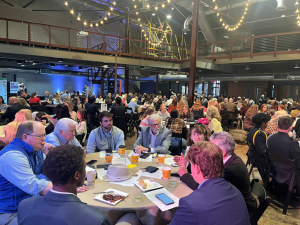 Rather than treating the forum as a one-time consultation, local leaders used the findings to design a series of follow-up initiatives. A civic leadership cohort was established to bring together community members interested in developing facilitation and engagement skills, creating a pipeline of residents specifically targeted at engaging youth in civic decision-making. This effort culminated in a citywide participatory event, Breakfast with the Mayors, attended by approximately 450 residents, including 60 youth, during which community members engaged directly with elected officials in structured dialogue.
This progression—from listening to leadership development to sustained public dialogue—demonstrates how an unassuming, largely conservative community at the periphery can build a significantly robust set of practices that lead to an ongoing institutional practice. One result of this process was the creation of a youth council. Here, the goal is for participation to become embedded in regular governance routines rather than limited to episodic consultation.
Redesigning Decision-Making: Boulder, Colorado
A similar process of institutional adaptation occurred in Boulder, Colorado, where rising tension and declining trust in public meetings prompted local leaders to reconsider the design of civic participation. A civic infrastructure scan identified structural barriers to participation, including adversarial meeting formats and limited opportunities for collaborative problem-solving. Residents expressed frustration with testimony-heavy meetings that allowed individuals to speak but did not create meaningful dialogue among community members and decision-makers.

In response, the city convened a public forum to gather input on improving meeting design and civic participation. Insights from this forum informed the development of a first-of-its-kind deliberative city council study session. During this session, community members participated in facilitated small-group discussions on economic vitality with city council members. This redesign of a city council represented a structural change in governance practice rather than an incremental procedural adjustment. By transforming the format of decision-making meetings, i.e., removing the dais and microphone and sitting everyone together at a roundtable, Boulder demonstrated how civic infrastructure can reshape institutional behavior and improve the quality of democratic deliberation.
From Participation to Institutional Permanence: Decatur, Georgia
In some communities, civic infrastructure reform extends beyond procedural change to formal institutional codification. In Decatur, Georgia, local leaders sought to broaden participation and ensure that community input reflected the diversity of residents during a comprehensive charter review process. To achieve this goal, the city held the first civic lottery to select residents to serve on a charter review commission in the US, creating a body that more closely reflected the community’s demographic composition.
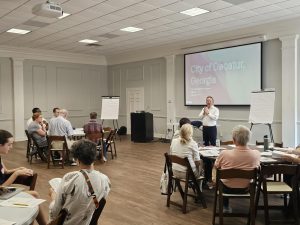 The commission’s work culminated in the adoption of a charter provision establishing public engagement as a core responsibility of local government. The charter explicitly recognizes engagement as essential to accountability, transparency, and inclusive decision-making and requires the city to promote equitable participation, monitor engagement outcomes, and report publicly on engagement efforts.
By embedding participation expectations within the city’s governing document, Decatur transformed civic engagement from a discretionary activity into a formal institutional obligation. This shift illustrates how civic infrastructure can move from practice to permanence, ensuring that participation remains a durable feature of local governance. Moreover, the practice of introducing sortition into a commission marks an opportunity for other communities to restructure how they encourage diverse, non-partisan public participation on advisory bodies.
Restoring Governance Culture Through Youth Participation: Mesa, Arizona
Institutional adaptation can also occur when governance culture becomes disconnected from public purpose. In Mesa, Arizona, escalating conflict at school board meetings had shifted attention away from student outcomes and toward polarized disputes. The district began allocating significant resources to security in response to contentious meetings, signaling a breakdown in trust between the board and the community.
 Rather than relying solely on enforcement or procedural controls, district leaders introduced a structured engagement sequence designed to reconnect governance with student experience. The initiative began with a recurring “question of the month” distributed to students across the district to gather input on issues affecting their daily lives. Student responses consistently identified cell phone use as a pressing concern. In response, the district convened a student-led innovation event, “Hacktivate,” in which students collaborated to design policy solutions addressing the issue. The process culminated in student teams presenting their recommendations directly to the school board in a public session, where their ideas were discussed as part of formal governance deliberations.
This sequenced approach—from student input to collaborative design to public presentation—reoriented board governance toward student outcomes and created a visible pathway for youth participation in institutional decision-making. By positioning students as contributors to governance rather than subjects of debate, the district demonstrated how civic infrastructure can stabilize governance culture and restore institutional legitimacy.
Reforming Neighborhood Governance: Anchorage, Alaska
A broader system-level example of institutional redesign can be observed in Anchorage, Alaska, where community councils serve as a formally recognized layer of neighborhood governance connecting residents to municipal decision-making. Civic infrastructure assessments conducted across the city revealed a consistent pattern: residents were engaged in their communities, yet confidence that participation influenced decisions was uneven. Participation was often concentrated among a small group of repeat attendees, and engagement structures frequently prioritized procedure over dialogue. These findings pointed to a misalignment between engagement design and residents’ natural participation in community life.
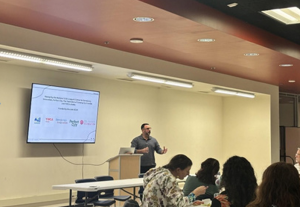 In response, local leaders are striving to implement reforms that shift community councils from a meeting-centered participation model to a relationship-centered civic ecosystem. The reform strategy included piloting facilitated dialogue formats, establishing transparent feedback loops, creating distributed leadership roles, and hosting community-based engagement activities outside traditional meeting settings.
These initiatives will be intentionally designed as institutional pilots to test whether redesigned engagement practices could broaden participation, strengthen trust, and sustain leadership capacity over time. The Anchorage experience illustrates how democratic resilience might emerge through iterative institutional reform rather than one-time innovation. The implication of this work is broadly applicable to neighborhood governance structures across the county.
Conclusion
Strengthening democracy requires expanding and sustaining the civic infrastructure that enables residents to participate meaningfully in public life. The durability of democratic norms depends not only on formal institutions, but on the everyday practices through which communities organize participation, deliberate collectively, and hold public officials accountable.
The cases presented here demonstrate that democratic resilience emerges through a sequence of intentional actions. Communities identify participation challenges, test new engagement practices, and adapt governance structures over time. These processes create resilience by embedding participation within the routines of governance. Yet the strength of civic infrastructure is not evenly distributed across communities, making the expansion of civic opportunity a central task for democratic renewal. The lesson, then, is to also turn our attention to supporting civic infrastructure at the periphery so that it can enable democracy to adapt, evolve, and endure.
Nick Vlahos is Managing Director of the Center for Democracy Innovation at the National Civic League.