By Maja Viklands Harris
On an overcast fall morning in Portland, Oregon, bleary-eyed reporters filed into a city press conference. The night before, November 8, 2022, voters had approved a sweeping reform measure1 to overhaul both the city’s electoral system and its form of government. As journalists greeted each other, an unspoken line hung in the air: I guess we’re really doing this.
Photo courtesy of the City of Portland.
At the podium stood Portland’s (now retired) Chief Administrative Officer, Michael Jordan, alongside members of the citizen-led Charter Commission, an appointed body of twelve volunteers tasked with reviewing the charter and suggesting changes every ten years. The commission designed the measure. Jordan, normally behind the scenes as the mayor’s administrative right hand, now found himself—almost overnight—in a public-facing role as the leader of the transition. The to-do list was daunting. He had to wind down Portland’s century-old commission system 2 and replace it with a mayor-council structure supported by a professional city administrator—a role he would eventually be tapped for. Another major undertaking was standing up four new council districts, each set to elect three members by proportional ranked choice voting. That change would make Portland the only major U.S. city using proportional representation3, placing the city at the center of a national conversation about election reform.
The clock was already ticking. The November 2024 election would fill every seat in the expanded government, and by January 2025, a twelve-member council—most of whom had never held public office—would walk into City Hall needing immediate support. Last but not least, there was the staff. Roughly 7,000 city employees would need to be guided through a full organizational restructuring—new reporting lines, new workflows, new expectations—without any service interruptions. As charter commissioners passed a symbolic baton to Jordan, he acknowledged the scale of what lay ahead. “This baton and the transition that it represents is both an honor, and I should say, a lifetime’s worth of challenge, for me and for the staff here at the City of Portland,” he told the crowd.
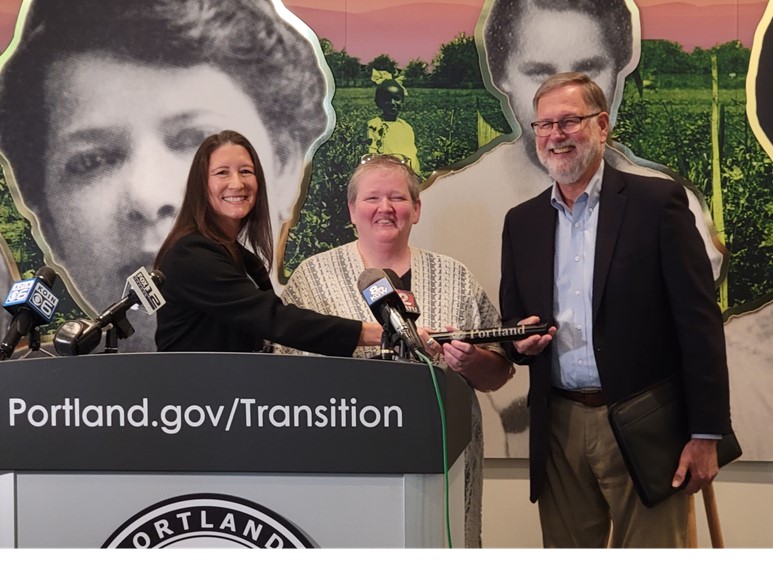
Charter Commissioners Brenda Ketah (left) and Debra Porta (middle) pass a symbolic baton to Michael Jordan on November 9, 2022. Photo courtesy of the City of Portland.
That challenge is now nearly complete. Jordan—whose career included senior administrative roles in city, regional, and state government, as well as elected service as a Canby city councilor and Clackamas County commissioner—retired from his role at the end of 2025. Before handing off the reins to his successor, Raymond C. Lee III, he agreed to sit down for an interview. Here, he reflects on his experience leading one of the most extensive government transitions in modern history.
Q: Roughly three years ago, you called this transition a “lifetime’s worth of challenge.” Do you still feel that way?
A: I think so. This is my forty-first year in public life, and the last three have probably been the most challenging. The first year of COVID was similar, but this transition has certainly been the most intellectually challenging undertaking—and the most challenging to my leadership and managerial ability—that I’ve ever faced.
Q: The day after Portlanders passed the reform measure, your team showed up with a transition plan. What was the reasoning behind beginning the work two years before the new government was elected?
A: I’m glad it appeared like we had everything planned, because we certainly didn’t. My team knew there were certain required things that had to happen to hold a November election two years later. Some of those things had to be front-loaded, like creating the new council districts and making changes to the city’s elections code. But we did not immediately have a plan for how to change the organizational structure. It took us until November 2023 to put a new organizational framework in front of the then–city council.
Q: The reform measure required you to stand up both a District Commission to draw the new district lines and a Salary Commission to set compensation for the new government. Your team also decided to assemble a citizen-led Government Transition Advisory Committee to offer guidance on your work. Is that something you would recommend for cities navigating reform?
A: We realized early that there were a lot of moving parts to this measure, and we knew the community was going to care a lot about how this all played out. And, to be honest, there was a fair amount of skepticism that the city could actually deliver on this big of a change to its own structure. We knew we were going to need some folks from the community to help us—particularly with outreach—and to make sure we were capturing the intent of the words in the ballot measure.
As the process evolved, they turned out to be a wonderful asset. Their formation was not without controversy, however. The then–council was not necessarily enamored with having a group of citizens put their fingerprints on the organizational structure. There was a fair amount of tension early on until everybody found their footing and understood the role they were going to play.
Q: For over a century, Portland had a government where the mayor and four city commissioners each managed a set of city bureaus. Bureau directors were used to reporting to whoever was elected at the time. What has it been like converting the commission-based system to a central command under the mayor and city administrator?
A: The central authority feature of the reform measure is playing out the way I thought it would. Maybe not as fast as I’d hoped, but the notion of accountability within the management of the organization changed almost instantly. With a single point of authority in the organization, there is clearer accountability for who’s making decisions.
What I didn’t anticipate were the gaps between the day-to-day management of the organization and the political part of the organization. Almost immediately, the entire administrative arm of the organization became associated with the mayor. For the legislative branch, it tended to look like it was the mayor making all the decisions and that the whole organization was accountable to the mayor. Now, that’s technically true because the mayor is the executive. But it’s not the whole picture, because the administrator and the organization are also accountable to the council. (Portland’s charter stipulates that the city administrator reports to the mayor, but also delegates “proper and efficient administration of all city affairs” to the city administrator, and puts the administrator in charge of all bureau directors.) Technically, with nine votes, the council can remove the administrator.
For the long-term cultural health of the organization, I think the administration should perceive itself as being supportive of and accountable to both the council and the mayor. Frankly, the administration functions somewhat like a third branch of government—accountable to the executive, but independent in the way it supports the council, shares information, and helps the council make legislation.
We got off on a footing where the administration became associated with the mayor and not the council. It’s created some tension in the organization. I didn’t foresee that issue, and I probably should have.
Q: Do you think that’s specific to Portland, or is that type of tension inherent in a mayor-council structure?
A: I think it’s Portland-specific in the sense that the council, and to some degree the mayor, came in on the heels of voters saying, “This place is broken, and we need to fix it.” Don’t get me wrong, there certainly are things that need to be fixed, but not everything at City Hall is broken. The whole administrative side of city government is not broken. I’m still hopeful that the tension isn’t inherent in the form but connected to this unique shift that Portland experienced.
Q: The council elected in 2024 was the first council elected under proportional representation. It is arguably Portland’s most demographically diverse council to date. It is also more politically diverse than past councils, producing a fair amount of disagreement. From an administrative standpoint, how would you describe the experience of working in that environment?
A: At my confirmation hearing, I mentioned that this was the most diverse council, I think, in Portland’s history. That is both a blessing and a curse. Diversity of opinion is helpful if it’s healthy and managed well, but it can also be a real challenge to move legislation forward and to find consensus. Most of the things we do every day for Portlanders aren’t very sexy, and they aren’t very controversial. But this council, with its diversity of opinion and this notion that the city needs to be fixed, sometimes makes it hard for us to just do the regular business of the city. We need to put the right systems in place to move regular city business through the council while simultaneously allowing the council to innovate and create new policy. We’re still struggling with that, and day-to-day business sometimes gets caught up in the more controversial things. To be fair to the council, the federal government has done us no favors this year. This council walked into a really challenging situation that no other council has had to face.
Q: And are you referring both to the loss of federal funding and the Trump administration’s decision to deploy National Guard troops in Portland?
A: I’m referring to all of our relationships with the federal government. It’s been very challenging since mid-year for this council, and I give them kudos for how they have managed the situation. I think Portland has managed it about as well as it could be managed—and that’s something we hear a lot from other cities.
Q: You have experienced some very pointed, and very public, exchanges with councilors who are frustrated with the executive branch. What’s your best way of handling negative feedback in a public setting?
A: I’ve done this job with many councils and many elected officials. I’ve been an elected official twice, and I respect the role that they play. At the end of the day, I may know a lot more about what’s going on than they do, but nobody elected me. They got elected. They speak for the people of this city. I always try to keep that in mind.
I also realize that they live in a different world than we do. They live in two- and four-year life cycles, and they live with a constituency that can reach out and grab them at any moment for any issue. They’re caught in the middle of that world. I try to keep that perspective and listen between the words to understand where it’s coming from and what’s behind it. If I can keep my head there, that keeps me calm, it keeps me focused, and it helps me not respond emotionally or match the energy around the topic. My job is to be the calm one. My job is to try to be rational in every case. I know I’m not always successful, but most of the time I am.
Q: During 2025, the City of Portland experienced a significant budget shortfall that led to layoffs and cuts to services. What has it been like to lead staff through that experience?
A: It’s the most difficult part. When you’re going through a lot of change, and you have that tension we talked about, and then on top of that, there are folks working here who will not be with us next year, it brings home to you—especially when you’re in a leadership position—just how human this work is. To me, they’re not numbers on a piece of paper. They have real lives and families. It’s just very, very hard. And it’s going to go on for some time, because we have another challenging budget cycle coming up. I just hope, no matter how long it goes on, that we never get used to it.
Q: Do you think you’re leaving City Hall better than you found it? If so, what has been your best contribution?
A: Oh, that’s hard to say. Hopefully, I’ve been able to communicate, with relative consistency, the direction that the city needs to move in. I hope I’ve been able to strike the right balance between comforting people and kicking them in the butt. Hopefully, I’ve been consistent. Hopefully, I’ve been patient. And hopefully, you know, I’ve lent a notion of empathy and support to the people who work here. I have so much respect for what they do every day. They do thankless work that has to get done, and they usually only get attention when something goes really poorly. Hopefully, I’ve left this place a little more human.
Q: Is there anything you wish you had done differently?
A: Oh, sure. While we were preparing for how to support the new mayor and new council, the perpetual question was, “How much do we bake it before they get here?” Our biggest mistake was probably that we did too much too soon, because they resented us making those decisions for them, and sometimes rightfully so. I think that got us off to a bit of a rocky start, particularly around how many staff they could have and how big their office budget was. We probably should have waited and just built contingencies into the budget so that we could have been more nimble when they came in.
Q: As you hand off the reins to your successor, what guidance will you give him?
A: What I would tell anybody coming into a job like this, at this scale, is that the “tyranny of now” is overwhelming. There are so many things waiting at that door every morning. If you want to be really good at this job, and if you want to do it for more than just a couple of years, you need to build relationships, and you need to understand how things work and how people are feeling about how things work.
I would say at least half of your time should be spent learning. Learning what we do and how we do it, learning about the community, learning about the council. Spend your time building relationships. This might sound surprising, but this place can run itself. Quite frankly, this is not a management job. It’s a leadership job. And to be a leader, you have to understand people, and you have to have relationships. Also, you’re going to get a little bit of a honeymoon. When you first start, people will give you a little bit of slack. Take every bit they’ll give you and learn the place. That’d be my advice.
Q: Many reform advocates are looking to Portland to evaluate whether proportional representation, popular around the world, is a good fit for the United States. Do you believe our unique structure is a model for other cities?
A: It’s only five years until we have to stand up the next Charter Commission, and you can bet the first thing they’ll ask is, “How has it worked? What have we learned? What tweaks can make it better?”
I think our system of ranked choice voting, combined with multimember districts, allows people to get elected from a relatively narrow base. That means some folks have a narrow constituency, and that can be a challenge. Maybe with twelve different constituencies, it’ll balance out. I think it might be good for the mayor to have a veto, and that’s something the next commission will probably look at.
Having said that, this system has clearly brought us the most racially diverse council we’ve ever had, and probably one of the most diverse councils nationwide in terms of their thought process. I think that’s mostly a good thing. One drawback this first year is that it’s been a little chaotic, and that’s because there aren’t yet enough accepted rules about how we do things—how you move a good idea into legislation, how the sponsor and the administration interact, and how that interaction can be productive rather than antagonistic.
Will it work in other places? I think it could, especially in cities that struggle to diversify their elected bodies or need a broader range of thought about how cities are managed. Personally, I’m not a big fan of separate branches. I would have preferred a council–manager form. If it were me, I would have put the mayor on the council and had thirteen members, and if they were elected with ranked choice voting from multimember districts, so be it.
In this form of government, we really have three branches, but it’s not fully perceived that way right now. We’ve got to find our cultural norms about their respective roles—how that dance works. It’s going to take some time, but I think they’ll find their way.
Maja Viklands Harris is the founder of Rose City Reform, a journalism and research project dedicated to tracking Portland’s reform process. She writes the monthly Rose City Reform Substack and is also the host of the Stump Talk podcast, where she interviews elected leaders and political experts about Portland politics.