By Jamie Boex
Introduction
Local governments provide the public infrastructure and public services that enable communities to function and people to live together. Providing these services requires governments to raise revenues, make choices about how limited resources are used, and balance spending with available resources over both the short and long term. Governments therefore have an obligation not only to account for the money they collect and demonstrate that it is spent wisely, but also to explain these choices clearly to the people they serve.
Sharing the budget with constituents in ways that ordinary citizens can understand is therefore more than a matter of good budgeting or financial transparency. It is part of the social contract between citizen-taxpayers and their representative governments. Citizens should be able to understand, at a practical level, where public resources come from, what they pay for, what services and infrastructure those resources support, and the tradeoffs elected officials face in allocating them.
This challenge exists at every level of government, but it is especially relevant at the local level. Local government is the level closest to the people: residents encounter the benefits of local government programs on a daily basis through the public schools, streets, parks, libraries, public safety, land-use decisions, sanitation, and numerous other services that shape everyday life. Yet local budgets are often presented primarily as technical financial documents rather than as tools for communicating these choices to citizens.
Making local budget information accessible and meaningful is therefore an important foundation for informed civic engagement. As such, the objective of making local budget information accessible and meaningful should extend beyond making financial information publicly available through a data portal or having a single high-quality budget document. If local governments truly want to be “government of the people, by the people, for the people,” they should proactively translate their budgets into insights that residents can understand and use—helping citizens see the connection between the revenues they contribute, the choices their representatives make, and the public value their government provides.
Citizen engagement and citizen trust start with informed citizens
Local governments around the U.S. differ considerably in the degree to which they engage citizens in public decision-making. While public participation mechanisms are common—including public hearings, community meetings, citizen academies, and advisory bodies—many engagement processes assume that residents already possess the background knowledge needed to participate meaningfully in local decision-making. This challenge is especially visible in local government budgeting.
Most local governments in the United States formally invite citizen input into annual budget decisions. However, participation often occurs after release of lengthy and technical budget documents that were prepared primarily for elected officials, administrators, and finance professionals. As a result, citizens who lack budget expertise, or who have limited time or opportunity to acquire it, find themselves effectively excluded from meaningful participation. These barriers tend to be especially pronounced for communities that have historically had fewer opportunities to engage with public institutions, including minority and underserved populations. As such, making local budget information accessible and meaningful to constituents ensures a more inclusive local budget process, where residents are not precluded from having a voice based on their ability to absorb highly technical budget documents.
In addition, communicating budget information in a more citizen-centric manner provides value beyond the (often relatively small number of) residents who actively participate in budget hearings or civic processes. Most citizens engage with local government more passively: as voters, taxpayers, service users, and community members who rarely attend public meetings or read technical budget documents. By helping citizens better understand where public resources come from, how public services are funded, and what trade-offs local governments face, ensuring a more accessible and meaningful presentation of budget information can strengthen public understanding and improve trust in government—even among residents who do not directly participate in the local budget formulation process.
From transparency to understanding: what is a Citizen Budget?
Traditional public sector transparency approaches often focus on making information available. By this measure, governments in the United States are among the most transparent in the world: federal, state, and local governments make vast amounts of information, including detailed revenue and expenditure data, publicly accessible. Yet citizen-centered governance requires going a step further. Information must not only be available; it must also be understandable.
Many local governments provide residents with a “citizen’s guide to the budget” or a “budget in brief,” typically offering definitions of technical terms or explaining the budget process. While useful, these materials frequently assume that citizens must acquire the language and skills of budget professionals in order for them to engage in the local government’s budget process. Moreover, budget summaries seldom provide sufficient context or insight to stand on their own, requiring interested residents to refer back to the much longer and more technical budget document to understand what the numbers actually mean.
By contrast, Citizen Budgets start from the opposite premise: public institutions should communicate in ways that are accessible to ordinary citizens. Enhancing trust in government and ensuring effective public participation and citizen engagement requires that local governments communicate about their policy choices in an inclusive manner, which requires them to move beyond providing public access to data and information to sharing meaningful insights with their citizens about local budgets, finances, and performance.
A Citizen Budget can be defined as a budget document that is accessible to citizens who are not expected to have specialized knowledge of public budgeting or public finance. Citizen Budgets provide a transparent overview of the local budget proposal in a way that is understandable and engaging for ordinary citizens—by making use of graphs, simplified formats, or interactive tools—thereby enabling and encouraging greater public participation in budget discussions.
The International Budget Partnership (IBP) played an important role in advancing citizen-centered budget transparency worldwide beginning in the early 2000s, a period when democratic governance and citizen participation were gaining momentum globally. Through its work on open budgets and the promotion of Citizens Budgets, IBP helped establish the principle that meaningful fiscal transparency requires governments not simply to publish budget information, but to present it in accessible, nontechnical forms that ordinary citizens can understand and use.
Why public budgets are difficult for citizens to understand
To understand the value of Citizen Budgets, it is important first to understand why conventional public budgets are so difficult for ordinary citizens to understand. Public budgets are among the most important policy documents governments produce, but they are rarely designed with citizens in mind. Several factors contribute to this challenge.
First, local budget documents are typically designed first and foremost as decision-making and management tools for elected officials, executives, department leaders, budget professionals, auditors, and oversight bodies—not as communication tools for ordinary citizens. As a result, budget documents are often extremely long and highly technical. Citizens reasonably expect public officials to manage complexity on their behalf and may not wish, or be able, to navigate hundreds of pages of financial tables.
Second, budgets are typically expressed in millions or billions of dollars, making it difficult for residents to relate spending decisions to their own experiences. Presenting information per household, per resident, or in terms of everyday public services can make government finances more understandable.
Third, citizens often underestimate both the breadth and complexity of local government responsibilities or overlook how many public services depend on local spending. While local taxes (such as the annual property tax bill) tend to be highly visible and relatively “lumpy,” these funds are expected to finance dozens of different functions at once: public schools, policing and emergency response, parks and libraries, roads and transportation, land-use planning, building permits, and local administration, among many others. Without visibility into the full portfolio of local services provided, taxpayers may focus primarily on the size of the local budget and a tendency to desire lower taxes, rather than weighing the costs and benefits of the full range of infrastructure and services that local revenues support. Citizen-centered budget communication can help place public expenditures, including administrative and staffing costs, in context and strengthen understanding of the public value being delivered.
Fourth, unlike local taxes and fees, which tend to be highly visible and directly felt by local taxpayers, intergovernmental fiscal flows are often invisible. Citizens may not realize how local services are financed through combinations of local taxes, state support, federal resources, and shared responsibilities. As a result, residents in some communities may underestimate the extent to which their local services depend on external (state and federal) funding, while residents elsewhere may overestimate the local tax burden required to sustain public services. A well-designed Citizen Budget can help make these intergovernmental connections visible by showing not only where local revenues come from, but also which level of government pays for which services and how resources flow across levels of government to support outcomes that citizens experience locally (Figure 1).
Figure 1. Following the money: from public revenues to local services
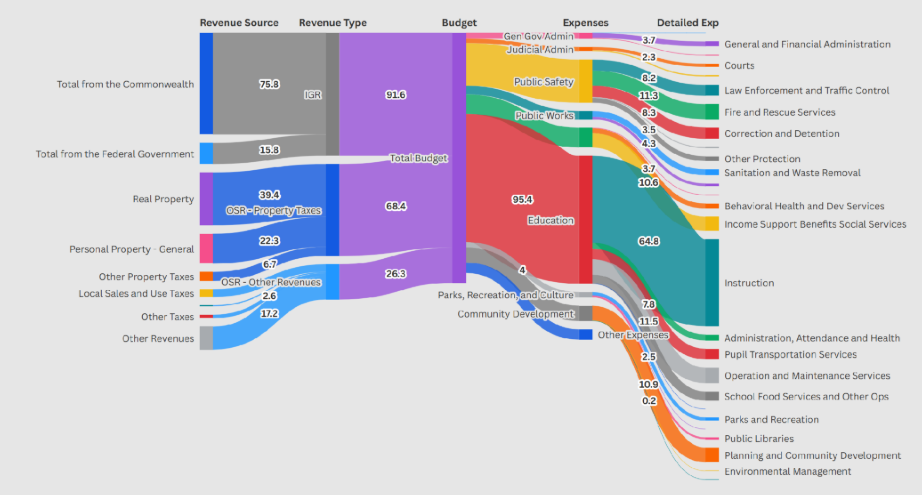
Example of Shenandoah County, Virginia, in millions of dollars (Source: Prepared by author based on Virginia Auditor of Public Accounts data)
Local government finances can also be difficult to understand because the boundaries of a “local budget” do not always correspond neatly with the services residents experience. A local government’s total budget may include capital accounts, special-purpose funds, or other non-general-fund activities that can make headline spending figures misleading. At the same time, “local” services may be provided and financed by multiple overlapping jurisdictions—including counties, municipalities, school districts, authorities, and special districts. Citizen-centered budget communication should therefore help residents distinguish between different funds and clarify which public entity is responsible for (and pays for) which services.
Finally, traditional local media once played an important role in translating public decisions into accessible narratives and helping people make sense of local public finances. Today, fragmented media environments and increasing reliance on social media place greater responsibility on public institutions to communicate clearly, accurately, and credibly. When public information is difficult to understand, confusion and mistrust can grow—and public institutions become more vulnerable to misunderstanding, misinformation, and politicized narratives.
Citizen Budgets within the spectrum of citizen participation
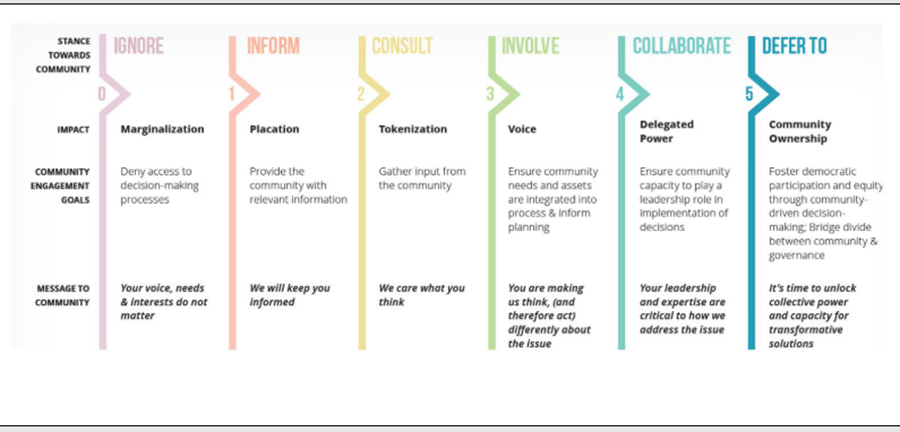
Public participation and citizen engagement can be understood as existing along a spectrum: from informing citizens, to consulting them, to involving them directly in decision-making and collaborative governance. Citizen Budgets are not intended to replace public participation or citizen engagement. In fact, Citizen Budgets intend to strengthen these processes.
Different communities may pursue different levels of participation depending on local preferences, resources, and institutional culture (Figure 2). Some communities may prefer representative decision-making with limited direct participation, with few citizens participating in public hearings as long as the trash is picked up and local services are provided. Other localities have much more participatory traditions and practices, engaging in more participatory and collaborative local governance approaches.
Figure 2. The spectrum of community engagement to ownership
More intensive forms of engagement can extend beyond consultation to give citizens a direct role in shaping public spending priorities. For instance, in a recent article for the National Civic Review, Nick Vlahos proposes a “resident model of government” in which residents are treated as active participants in local governance, supported by institutionalized public engagement and transparent, two-way communication. While communities may differ in how far they wish to move toward such participatory models, meaningful engagement requires residents to have sufficient information and context to understand the choices before them. Accessible and understandable budget information is therefore an important part of the civic infrastructure needed to support more informed resident participation.
Citizen Budgets operate primarily within the inform and consult stages of participation by ensuring that residents understand the issues before being asked to provide input. In communities pursuing more participatory or collaborative approaches, accessible budget information becomes an important foundation for deeper engagement. Regardless of the extent and nature of public participation in the local budget process, Citizen Budgets therefore represent a practical and scalable step toward greater transparency, more informed civic participation, and more responsive governance.
GFOA’s efforts to promote budget transparency and communication
The Government Finance Officers Association (GFOA) has long played a central role in improving the quality and transparency of state and local government budgeting in the United States. Building on its Certificate of Achievement for Excellence in Financial Reporting Program established in 1945, GFOA launched its Distinguished Budget Presentation Awards Program in 1984 to encourage and assist governments to prepare budget documents of the highest quality and help establish professional expectations for what a strong public budget document should contain.
Informed by its Rethinking Budgeting initiative, GFOA is in the process of updating the criteria for its Budget Presentation Awards Program for 2027, broadening its focus beyond the traditional budget document to encompass the wider range of ways governments communicate budget information to public stakeholders. These budget communication approaches include websites, dashboards, and other forms of communication between governments and their elected representatives, residents, and other external stakeholders. The revised criteria place greater emphasis on clarity of budget information, effective communication tools, transparency surrounding budget decisions, and a clear budget message that conveys key themes to public stakeholders. This evolution recognizes that effective budget transparency is not defined by the production of a single comprehensive document, but by whether governments communicate financial choices in ways that their audiences can find, understand, and use.
GFOA also promotes Popular Annual Financial Reports (PAFRs) as a way to present financial information in a more accessible format for residents. PAFRs represent an important step beyond traditional financial reporting by summarizing financial results and using visual and explanatory elements. Because they are generally derived from Annual Comprehensive Financial Reports (ACFRs), however, they tend to focus primarily on financial and accounting information. Citizen Budgets and related budget-communication tools can complement these efforts by more explicitly connecting revenues and expenditures to services delivered, policy choices, operational performance, and the everyday experiences of residents.
Taken together, these initiatives provide local governments with an important professional foundation to think of the budget not only as a financial plan and accountability document, but also as a public communication tool.
Examples of effective citizen-centered local budget communication
Citizen Budgets and related constituent-facing budget communication approaches are increasingly used around the world to make public finances more understandable and to encourage more meaningful citizen engagement. Examples of effective citizen-centered budget communication can be found both close to home and abroad.
In Virginia, Loudoun County’s Budget Story is an annual, resident-focused companion piece to the adopted financial plan that illustrates how county tax dollars fund county programs, staff, and capital projects. The document presents budget information through a more narrative- and visual-focused format than traditional budget documents and spotlights some of the ways the county puts tax dollars to work, helping residents connect revenues and expenditures to services and policy choices.
A somewhat different example comes from Washington, DC, where the DC Fiscal Policy Institute (DCFPI) annually prepares a constituent-facing Resident’s Guide to the DC Budget, which translates the District’s proposed budget into more accessible explanations of spending priorities, revenue choices, and their implications for residents. Rather than reproducing official budget tables, or limiting itself to providing a glossary of budget terminology, the guide seeks to provide additional context that helps readers interpret what the budget means in practice, including how resources are allocated, how public services may be affected, and what policy tradeoffs are involved. This example also illustrates that constituent-facing budget communication need not always be prepared by governments themselves; civil society organizations, think tanks, and other policy intermediaries can also play a complementary role in making public finances more understandable and supporting more informed public discussion.
Internationally, several cities have gone further in integrating transparency, performance communication, and citizen participation. Rather than relying on a single Citizen Budget document, Helsinki (Finland) places strong emphasis on communicating public value and service delivery outcomes to residents across all of its operations. For instance, the city’s annual report organizes information around departments and services, presenting staffing and operational information and connecting expenditures to the services delivered, often in relatable terms such as spending per resident.
Importantly, Helsinki’s approach to constituent-facing communication exists alongside a deeper participatory budgeting process rather than replacing it. Through Helsinki’s OmaStadi (“My City”) platform, residents are invited to submit ideas for improving their neighborhoods and city services, collaborate in refining proposals, and vote online for their preferred projects, which are then implemented by the city. This illustrates how accessible public communication and more direct forms of citizen participation can reinforce one another: citizens are first provided with context and information about how their government works and then given opportunities to shape future spending priorities directly.
Other European cities—including Amsterdam, Paris, and Barcelona—have developed constituent-facing budget and financial communication approaches that likewise place considerably greater emphasis on accessibility, visual presentation, and public understanding than more traditional budget documents. Rather than focusing primarily on financial compliance or accounting categories, these cities increasingly organize information around policy priorities, municipal services, neighborhood investments, and quality-of-life outcomes. While their specific formats differ, these approaches tend to present public finances through (static or interactive) visualizations, concise narratives, and service-oriented explanations that connect public spending to everyday resident experiences. To a greater or lesser extent in each of these cities, budget communication is integrated with broader transparency and participatory budgeting efforts, allowing residents not only to see how resources are allocated, but also to better understand the tradeoffs involved in public decision-making and the results their government seeks to achieve.
The push towards citizen-centered budget communication is not limited to Europe. For instance, Porto Alegre in Brazil—widely recognized as one of the pioneering global examples of participatory budgeting—demonstrated how accessible budget information and structured citizen engagement can empower residents to directly influence local spending priorities and strengthen public trust in local government. More recently, Jakarta (Indonesia) has developed Jakarta SMART APBD (Smart Budget), an interactive public budget platform designed to make the city’s budget more transparent and accessible to residents. Rather than publishing only formal budget documents, the portal presents budget information through integrated data, visualizations, explanatory materials, infographics, news updates, and supporting content intended to help users explore and better understand the city’s budget and budget preparation process. While the Jakarta platform remains primarily a transparency and information tool rather than a full participatory budgeting process, it illustrates how digital approaches can help move public communication beyond the publication of technical documents in a large and complex urban government.
While these examples differ in format and ambition, they illustrate a common principle: effective public transparency is not simply about publishing data or information—it is about presenting public information in ways that help citizens understand, interpret, and engage with government decisions.
Improving insight by presenting (local) budgets in per-household-per-month terms
One specific way to make local government finances more relatable is to recognize that households plan, budget, and spend on a monthly or per-unit basis: households think about what they spend each month on housing, transportation, food, health care, and everyday services. Likewise, one of the ways to convey local government finance data more clearly and understandably is by expressing public spending in amounts per household, per month, rather than only in (or in addition to) millions or billions of dollars (Figure 3). Online budget portals could readily allow users to switch between viewing local budget revenues and expenditures in millions, per capita, per household (per year or per month), or as a relative share, so that residents can consider the local budget in their preferred metric.
For instance, to the average citizen, it may be more meaningful to say that households in Fairfax County, Virginia, benefit from roughly 66 dollars per month in local law enforcement services, which is part of 211 dollars per month in public safety spending, than to say that the county government spends 1 billion dollars annually on public safety. Likewise, while it sounds like a large amount when Fairfax County spends 193 million dollars each year on parks, recreation, and culture, residents may find it easier to relate to the idea that this translates into only ten dollars per household per month for library services or 27 dollars per household per month for parks—often less than a gym membership or the cost of many common household subscriptions. Presenting local government finances in these more relatable terms can help residents better understand the value and breadth of public services that local governments provide.
Figure 3. Presenting budget information in per-household-per-month terms.
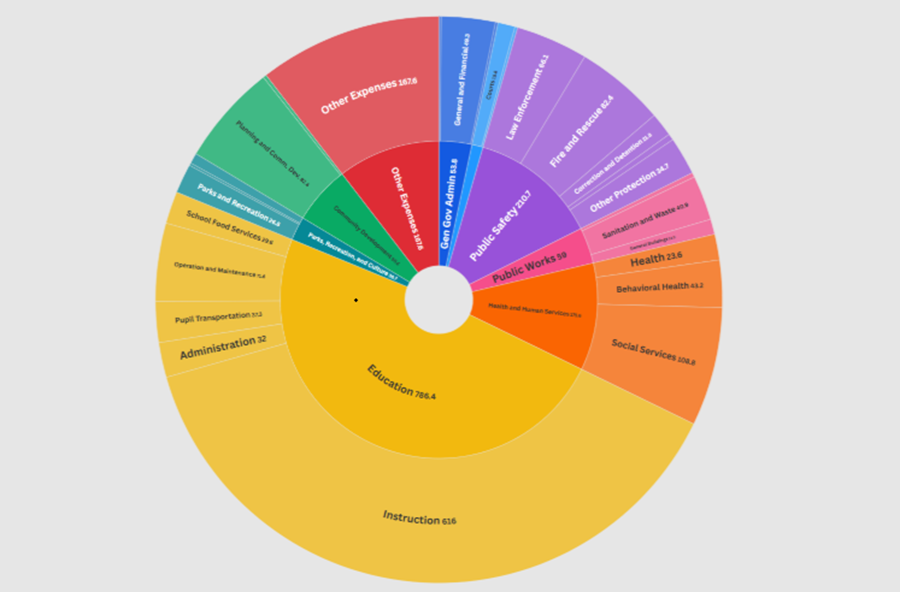
Note: Example of county expenditure in dollars per household per month for Fairfax County, Virginia (Source: Prepared by author based on Virginia Auditor of Public Accounts Data, FY 2025)
The same approach can be applied to local revenues, and can help citizens connect what they pay with the services those revenues support. Some local governments already illustrate how each “tax dollar” is divided among functions, but such presentations show only relative shares rather than what those choices mean for an individual taxpayer. Digital tools make it possible to go further. A property tax bill, for example, could be accompanied by a personalized breakdown showing how much that household pays in local property taxes each year and each month, and approximately how those dollars translate into monthly spending on schools, public safety, parks and libraries, transportation, and other services. The information could also show how the household’s contribution compares with that of the average or median local taxpayer. Such personalized budget information would connect the revenue and expenditure sides of the budget in terms that are directly meaningful to residents—helping taxpayers understand not only how much they pay, but what their dollars help provide.
The proposal to present government revenues and expenditures in more relatable terms brings into focus the fact that budget communication is often shaped by political-economy forces, and that the way in which fiscal information is presented is not always politically neutral. Local officials seeking lower taxes may wish to emphasize the cost of government by highlighting large aggregate tax or expenditure figures, or combine different categories of spending in ways that accentuate their size. Conversely, officials advocating for higher local spending may be concerned that voters perceive spending as excessive, and therefore may be reluctant to present budget figures in a more accessible format. Expressing spending in per-household-per-month terms does not eliminate these incentives, but it can provide citizens with a more meaningful point of reference. Importantly, the objective should not be to make government spending appear either large or small, nor to persuade citizens that a particular level of taxation or spending is appropriate. Rather, citizen-centered budget communication should present both the cost and the value of public services in context, allowing citizens to make their own informed judgments about whether public resources are being used wisely.
When a coordinated and collaborative approach is taken, and when AI tools are effectively leveraged, presenting local government budgets in a citizen-centric manner should be doable for even the smallest of local governments. While most states have a state-wide local finance portal that provides access to local budget information for all local governments in a state, their efforts generally provide access to raw local finance data rather than to budget insights. An online “civic observatory” could transform available data into insights at scale, allowing citizens direct access to analytic insights, while at the same time facilitating local governments’ efforts to produce more effective budget documentation.
From transparency to understanding: a call to action
The next step is not to invent an entirely new transparency infrastructure. Many of the necessary building blocks already exist. GFOA provides an important entry point through its professional standards, guidance, awards programs, and growing emphasis on effective budget communication. But this responsibility should not rest with local finance officers alone: local budget transparency and clearly communicating that local taxpayers’ dollars are spent prudently should be understood as a foundational whole-of-organization responsibility, rather than an optional good practice. As such, local governments should build on the existing foundations to integrate citizen-centered communication as a routine part of local government operations and the local budget process—not as an optional summary produced after the “real” budget has been completed. For instance, to the extent that local governments already offer citizen academies or other civic-engagement programs, these programs can incorporate basic budget literacy (and citizen budget portals) so that residents are not only aware of local budget processes, but so that they are actually better prepared to evaluate or participate in public budget decisions.
Other stakeholders can also play important roles in strengthening the foundations of transparent, inclusive, and participatory local democracy. National and state associations representing counties, municipalities, school districts, and other local governments can promote better and more inclusive budget communication, share templates and good practices, and potentially even establish platforms that help smaller local jurisdictions produce and share budget insights in ways that may be difficult for local jurisdictions to produce independently.
State governments can do more to require, encourage, and incentivize meaningful local fiscal transparency. As noted, many states already collect and publish comparable local government financial data. The next step is to complement these data with tools that help residents interpret them: comparisons across jurisdictions, accessible visualizations, explanations of revenues and services, and indicators that place local finances in context. International approaches such as the Philippines’ Seal of Good Local Governance illustrate how higher levels of government can use recognition and incentives to encourage transparency and good local governance.
Civil society also has a role. Leagues of voters, chambers of commerce, neighborhood organizations, civic groups, local media, and other community institutions should expect governments to explain public finances in ways that ordinary residents can understand. Where governments lack in-house capacity, local universities, nonprofit organizations, and civic technology organizations can help translate existing public data into accessible information and demonstrate what better communication can look like.
Public administration scholars should contribute as well—and should work across disciplinary boundaries to do so. Improving budget communication draws on public finance and budgeting, but also on communications, data visualization, behavioral science, civic engagement, political science, and other aspects of public management. More research is needed, not only on whether governments disclose information, but which forms of communication actually improve public understanding, broaden participation, and strengthen trust.
The practical objective is straightforward. A resident should not need to be a budget analyst to understand what their government does with public money. This is true across all government levels, but especially at the local level. Local governments should be able to explain, in clear and relatable terms, where the money comes from, where it goes, what services it supports, and what choices and tradeoffs lie behind the numbers. Moving from transparency to understanding would make local government budgets not merely financial documents, but a more meaningful part of the relationship between citizens and their government.
Jamie Boex is the Executive Director of the Local Public Sector Alliance (LPSA), a global professional network of advocates for inclusive and efficient decentralization, localization, and multilevel governance.