By Laura Rigell
Imagine a world in which all people experience their voices mattering in civic life, and community members are empowered and equipped to act together on shared challenges. Bridge-building, community organizing, and participatory democracy each get us part of the way there, but keep falling short of what seems to be required to support durable and inclusive civic action. But how about when these three fields are actually operating in sync, each offering their unique contributions at the moments when they are needed?
The SHIFT Action Lab initiated the Parkersburg Engagement Project as a 1-year pilot to find out and test its central hypothesis: the fields of bridging, organizing, and participatory democracy can have a greater impact when combined, compared to when they operate in isolation.
The SHIFT Action Lab is a cohort hosted by SHIFT, a family foundation, made up of ten representatives from ten organizations from the bridging, organizing, and participatory democracy fields. As a first priority after launching in 2023, the Action Lab members decided to lead a place-based pilot project to find out if their approaches indeed add up to more than the sum of their parts.
An Inter-field Pilot in Parkersburg, WV
The Lab intentionally selected a location for the place-based pilot where one of the Lab member organizations was already working and there was an eagerness by local residents to lead the effort on the ground. After considering four proposed communities, the Lab selected Parkersburg, WV (suggested by a Lab member from the organization WV Can’t Wait) in late 2023 as the site for the pilot.
The resulting Parkersburg Engagement Project is a noteworthy civic action project, not only because of the hundreds of community members engaged in this small West Virginia town and the momentum underway to take action on the complex issue of substance abuse, but also because of the methodology used behind the scenes. Through its intentional integration of bridging, organizing, and participatory democracy skills, the approach piloted in Parkersburg offers a fresh and nuanced contribution to the civic engagement space and is ripe for further experimentation and replication.
The Lab laid out a high-level structure and set of desired outcomes for the pilot, with the intention to allow a local team of Parkersburg residents to shape the details and lead the implementation. The core elements of the pilot pre-defined by the Lab were as follows:
- Implement a civic engagement initiative leading to concrete action, using a phased approach: 1) come together, 2) identify an issue, 3) identify a solution, 4) implement the solution.
- Engage a broad swath of Parkersburg residents, from diverse demographics, political orientations, and perspectives, led by a similarly diverse leadership team.
- Incorporate skills from the fields of bridging, organizing, and participatory democracy.
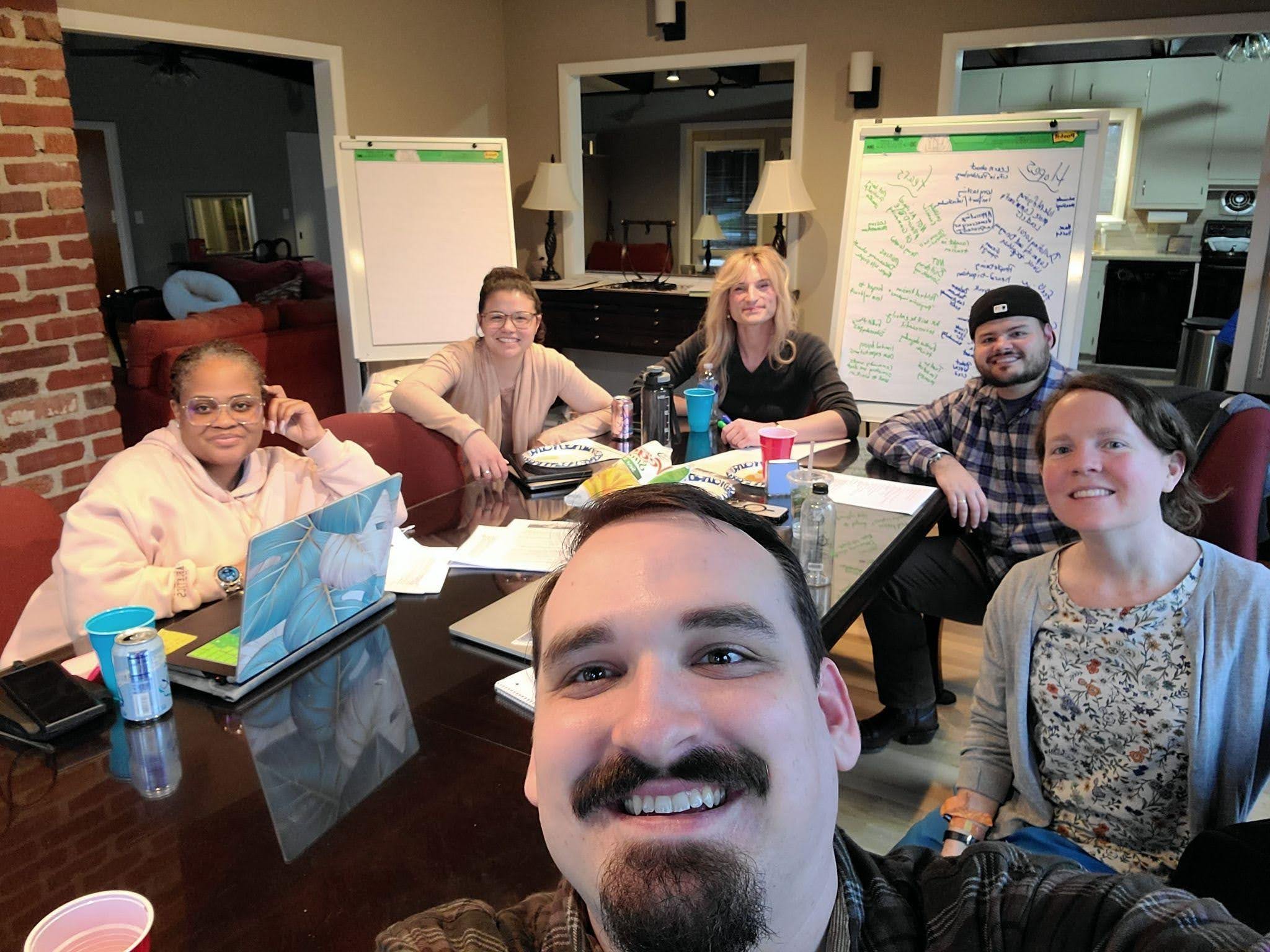 Early planning meeting of Lab members in Parkersburg, WV (March 2024)
The Lab fundraised from SHIFT and other foundations to cover the pilot’s costs. At the suggestion of WV Can’t Wait, the Action Lab included a $50,000 Solution Fund in the budget, to be used toward the implementation of the solution identified. Providing funding for implementation was a priority so that participants could see their input lead to concrete action.
Wendy Tuck, a Democrat City Council member and partner of WV Can’t Wait, expressed interest in having the pilot take place in Parkersburg, and her enthusiasm and track record of engaging her constituents were factors in the Lab selecting the city. As a first step, the Lab requested that Tuck find a person to co-lead the project with her who identifies as Republican, to ensure that political diversity was built into the leadership team from the start. Lisa Doyle-Parsons, Executive Director of Circles Campaign of the Mid-Ohio Valley, accepted Tuck’s invitation and stepped up as co-lead.
Tuck and Doyle-Parsons titled the effort the Parkersburg Engagement Project and opted to proceed with a Steering Committee model of leadership (based on a suggestion offered by a Lab member from the Participatory Budgeting Project). Tuck and Doyle-Parsons recruited seven other community residents to serve on the Steering Committee and convened the group for the first time in December 2024. The Steering Committee then set out to identify the issue most impacting Parkersburg residents, which would determine the focus of the project. Based on the results of a community-wide survey, which was mailed to each Parkersburg household and distributed in-person and online, the Steering Committee identified substance abuse as the focus issue in May 2025.
Community meetings included a panel of experts on the topic, followed by break-out discussions to come up with solution ideas, which were then presented back to the room (Sept 2025)
The Steering Committee then spent the summer collecting solution ideas from community members, asking people to offer suggestions on how to prevent substance abuse, reduce substance use, or reduce the impacts of substance use on the Parkersburg community.
Through 25 community events and focus groups, the Steering Committee collected more than 500 solution ideas. The Steering Committee shaped the most frequently mentioned ideas into an action plan, which is being implemented in 2026 and consists of:
- A “Lived Experience Council” of people in recovery to offer peer-driven support and create volunteering opportunities for people in recovery
- A marketing campaign aimed at publicizing available resources and reducing stigma of people in recovery
- A “Providers Council” of recovery and addiction professionals to improve the continuum of care among their offerings and engage in professional development so that those in recovery are better served.
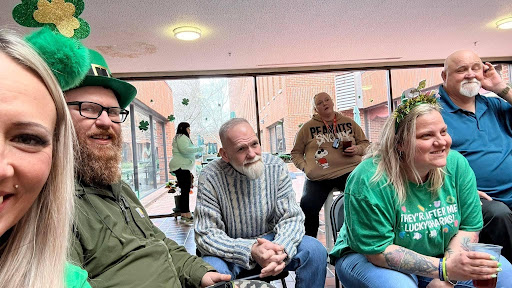
Sober St. Patrick’s Day Party hosted by the Lived Experience (March 2026)
Indispensable Contributions from Bridging, Organizing, and Participatory Democracy
The Action Lab members accompanied the Steering Committee on their journey from the pilot kickoff to the current implementation phase, providing training and coaching from the three fields to support the Committee in their work. There were several key moments in the course of the Parkersburg Engagement Project that illustrated the importance of each of the three fields of bridging, organizing, and participatory democracy, demonstrating that such a project could significantly fall short of its goals without their combined contributions.
“When we came up against a challenge, the Lab members would say ‘Look this is what we tried in this community and here’s how it worked.’ So we went ‘ok, so let’s try that,’ and it worked. So we could take the next step. What I’ve seen with the Parkersburg Engagement Project is it allowed us to keep moving forward.” – Wendy Tuck, Parkersburg Pilot Co-lead
Task delegation
The experience of the workload falling on the shoulders of one to two main leaders is very common. The people with the initial motivation and skillset often take on the vast majority of responsibility, and end up in danger of burnout and frustrated with their teammates for not stepping up more.
This dynamic started to play out in the Parkersburg Engagement Project during the “Identify Solution” phase. At a Steering Committee meeting, Tuck and Doyle-Parsons asked the Committee members to come to the next meeting with a date and location for a community event that they would each host to collect solution ideas. The next meeting came around, and none of the members had a plan in place. Tuck and Doyle-Parsons asked again, and at the next meeting, it was the same result: no other community events were planned beyond those that Doyle-Parsons and Tuck were putting on the calendar.
Tuck and Doyle-Parsons’s frustration and confusion started to grow, and they raised the dilemma with the Action Lab. In response, a Lab member from WV Can’t Wait agreed to come to Parkersburg and deliver a two-part training on shared leadership and task delegation. By the end of the second meeting, the Steering Committee had come up with the idea of the “Solution Series” (an ambitious series of eight community events in one month) and listed out all the tasks involved. Members were eagerly signing up for the different roles without being asked.
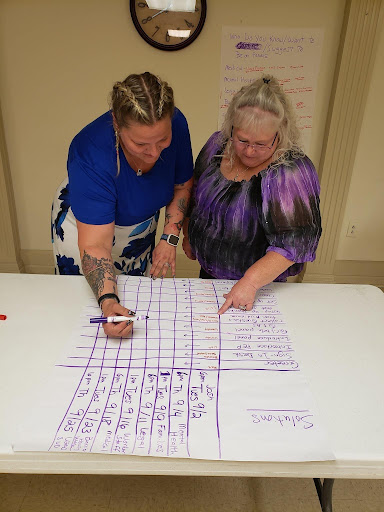
A Steering Committee member signs up for tasks related to upcoming community meetings (August 2026)
Addressing inter-personal tension
In the course of planning and executing the Solution Series, some light tension emerged between Tuck and Doyle-Parsons related to workload and direction of the events. Brenda Myers, Parkersburg Engagement Project Administrative Assistant, mentioned this in passing on a call about another topic to Laura Rigell, Action Lab Convener. In response Laura suggested that Myers use a tool that a Lab member from Essential Partners had recently trained the Steering Committee on called “Interviewing for Trust and Understanding.” Myers walked through the questions first with Tuck and Doyle-Parsons separately, such as “What would you like to understand better about the other’s perspective?” and “What questions do you wish they would ask you?” In their next leadership meeting, Tuck and Doyle-Parsons discussed how to better leverage both of their strengths in the project, set a regular weekly meeting time to allow for better coordination and the tension quickly dissipated.
Narrowing down ideas to a decision
Through the Solution Series and the 17 other community events and focus groups that the team hosted between May and September 2025, the Steering Committee had collected more than 500 ideas of interventions to address the issue of substance abuse in Parkersburg. On seemingly endless flip charts and hand-written notes, residents’ views and ideas had been judiciously captured. Now the Steering Committee was faced with the question – how could they narrow all of this great insight down into a specific action plan that they would implement?
In this case, Lab members from the Participatory Budgeting Project (PBP) stood at the ready to support. PBP offered several coaching sessions to the Steering Committee during this phase, helping them to cluster the ideas by topic area and then organize them all into a spreadsheet, so that they could assess patterns. Based on this analysis and some help from AI, the Steering Committee identified the ideas mentioned most frequently and arrived at an implementation plan.
Steering Committee members sorted ideas into categories, developed a proposal and then used consent-based decision-making to arrive at the action plan (Nov-Dec 2025)
In each of these examples, one of the fields offered a key contribution to the project’s success. Without the organizing acumen applied to the problem of task delegation, the project may not have reached as many residents and wouldn’t have resulted in as much leadership development for the Steering Committee members, who stepped up to take on more and more responsibilities over time. Without the help of bridge-building acumen, tension between the project co-leads could have limited their ability to be a united team leading the Steering Committee through the intensive process. Without the participatory governance acumen during the development of the implementation plan, the committee might have developed an action plan that was not actually informed by the input gathered, missing the opportunity for community members’ voices to have an impact on concrete outcomes. With all three of these skillsets at the table, the project was able to continue building momentum, reaching hundreds of community members and arriving at a plan informed by robust community input, which is now being implemented.
Areas for further development and focus
The 1-year Parkersburg pilot is only the start of what’s possible in this inter-field exploration. Alongside the inter-field synergy that was unlocked, there were several aspects that leave room for deeper contributions from each of the fields, or that remain challenging or unattained as of this writing.
Collaboration with local government
One of the desired outcomes of the Parkersburg Engagement Project was to “change local government processes, such that public participation is more meaningfully incorporated when addressing future public policy challenges.” This has not yet happened.
Engagement in the project by local elected officials (beyond Tuck) has been limited to date. Five of the nine city council members participated in interviews at the start of the project to offer their perspective on civic engagement in Parkersburg and four participated in follow-up interviews at the end of the project. For the Pilot Closing Celebration in Spring 2026, the Mayor acknowledged and expressed appreciation for the invitation, and apologized that he was unable to attend. Beyond that, neither the Councilor nor the Mayor have more deeply engaged with the Parkersburg Engagement Project.
Around the time of the launch of the Parkersburg Engagement Project (though not due to any activities of the project), city council voted that during Public Forum,the period in city council meetings when members of the public can offer comments, members of the public could only offer comments related to agenda items. Many residents were frustrated by this proposal, but despite their opposition, it moved forward. The Lab saw this as a potential opening for offering alternative forms of public engagement that could work better for both elected leaders and members of the public, such as ideas from the National Civic League’s Better Public Meetings project. Tuck and the Lab planned a session inviting a few council members to connect on the topic. However, Tuck was the only council member that attended (another was interested but unavailable on that date). The conversation did not deepen beyond that point and the Steering Committee opted to focus their attention on producing an action plan driven by the community, rather than basing their success on local government cooperation.
Perspectival diversity related to the issue
Tuck and Doyle-Parsons recruited the Steering Committee members to intentionally include demographic and ideological diversity; they also shared a commitment to include people who often do not typically have a voice in local civic life or politics. This led to a committee with two of the nine members being in recovery themselves, and three with experiences of homelessness. Around May 2025, two Steering Committee members stepped back from the committee: one due to personal capacity limitations and the other due to lack of interest in substance abuse specifically. Given this development, Tuck and Doyle-Parsons decided to add a few new members.
When the issue of substance abuse was identified, it became clear that there was another form of perspectival diversity which was lacking. Many Parkersburg residents express frustration with the negative impacts of “addicts,” expressing safety concerns, a desire to free up ambulance capacity for non-overdose emergencies, and a wish for less recovery infrastructure in town. This sentiment led to the city council’s decision in 2021 to put in place a moratorium on new recovery beds.
Despite some attempts, efforts to recruit new Steering Committee members holding this more critical perspective were not successful, which Tuck and Doyle-Parsons attribute partly to not having personal relationships with as many people holding that perspective. They did add three new committee members (who were in recovery themselves and/or working in the recovery space), continuing to tip the scales toward the more sympathetic perspective.
The Steering Committee made a specific effort to invite in a more critical perspective by having one of the Solution Series events focused on “Impacted Non-users,” with the goal of creating space for participants to speak freely about the reality of the challenging impacts on neighbors and community safety. On the whole, however, event attendees tended to be those who were in recovery, sympathetic to those in recovery, or working in the addiction and recovery space.
Onboarding new participants
Another limitation of the project to date is its capacity to onboard new participants beyond consulting them for their ideas. Given the leadership structure of the Steering Committee, which was a fixed leadership body in which members were compensated for their time, there was not a built-in structure for how to include newly interested community members who wanted to get more deeply involved beyond showing up at an event.
The lack of an organizing culture and vehicle (with a vested interest in growing a base of engaged residents) meant that reaching out and engaging more people into active roles was not prioritized. In response to the baseline survey in Spring 2025, 365 out of 621 respondents checked the box “contact me with invitations to engage further with the project;” another 302 people (out of 527 respondents) provided their contact information to the same question in the endline survey. These interested residents have not been systematically contacted or offered pathways to meaningfully contribute.
A Lab member from Make It Work Nevada has been training the Steering Committee members in the art of “one-on-one’s”, an organizing tool designed to onboard people to take on a role in an ongoing effort. The Lab’s intention is to start having one-on-one’s with those who have expressed interest, to invite them to support the action plan’s implementation.
The Action Lab is committed to continue supporting civic engagement work in Parkersburg, including exploring potential collaboration with local government, more inclusion of diverse perspectives, and intentional onboarding of new participants, among other areas. The Lab is in discussions with Parkersburg-based partners about what form ongoing work there may take. To dive deeper into the story of the Parkersburg Engagement Project from the perspective of the Steering Committee members, watch the 15-minute project recap video.
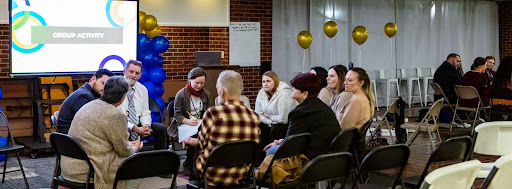
Break-out session to kick off Lived Experience Council at Pilot Closing Celebration (Feb 2026)
What’s next? Additional piloting opportunities and a Playbook
The Lab is also committed to supporting other place-based civic engagement efforts to experiment with the inter-field approach. Options being considered are: 1) targeted partnerships with other places or networks, and 2) capacity-building for civic hub builders to equip them with these indispensable skills and prepare them to build on others’ success, rather than repeat others’ mistakes.
To equip other community members, practitioners, and funders to apply the inter-field approach, the Lab is starting work on an “Inter-field Playbook,” a practical and interactive guide on integrating best practices from bridging, organizing, and participatory democracy in place-based civic engagement projects. Sign up here to stay updated on the Action Lab’s activities and to receive the Playbook as soon as it’s published.
Laura Rigell is the Action Lab Convener. Since conceptualizing the three-field framework through a landscape scan in 2021, Laura has shepherded the Lab’s co-creative and emergent process. Laura is based in Germany and works to support democracy and transformative group processes in both the US and Europe.
The Parkersburg Engagement Project was supported by the following organizations through their participation in the Action Lab: The People, WV Can’t Wait, Karuna Center for Peacebuilding, Braver Angels, United Vision Project, the Participatory Budgeting Project, Essential Partners, the National Civic League, Make It Work Nevada, Urban Rural Action, and the Horizons Project.