
Project at a Glance
- Issue Area Economic development, Fiscal sustainability, Workforce development/Adult education
- Engagement Approaches Community meetings (townhalls, forums, etc), Embedding a culture of engagement, Leadership programs, Neighborhood events/ activities, Partnering with residents, Surveys and data, Youth Engagement
Problem: Davie County is transitioning from an agricultural/blue-collar base to a high-tech manufacturing and logistics hub where 67% of jobs will require education beyond high school. Fewer adults currently have those credentials, creating a skills gap. No single program can solve this—only a cross-sector approach engaging employers, schools, government, and nonprofits can prepare youth for life after high school.
Goals:
- Inspire, educate, equip, and train students for postsecondary success and 21st-century careers.
- Align K-12 coursework and credentials with local industry needs and keep talent in-county.
- Expand equitable access to high-quality CTE pathways, credentials, and work-based learning.
- Strengthen employer–education partnerships (internships, externships, tours, co-taught/hosted courses).
Project Summary:
Davie Works is an umbrella partnership informally linking three pillars:
- Davie High School Career & Technical Education (CTE): Starts with middle-school exploratory courses, then 14 Career Clusters, 27 CTE Pathways, and 50+ courses at DCHS. On-site, industry-grade facilities include professional kitchens, multiple 3D printers, a seven-bay auto garage, woodworking/masonry labs, agriculture “working farm,” and new CNC plasma cutter, welding lab, and machining equipment. Students earn industry-recognized credentials (e.g., Microsoft, CAD; automotive, construction, agriculture).
- DavieCONNECT (DCEDC, launched 2018): “Force multiplier” that builds employer–education bridges via Manufacturing Day tours (middle school), Teacher Summer Externships (“teach our teachers”), student internships and apprenticeships, and deep employer site visits so educators can advise students with current, local labor-market insight.
- Career & College Promise (CCP) with DDCC: Expands pathways DCHS can’t host on campus (e.g., nurse assisting, emergency services, firefighting). Example: a student completed Health Science at DCHS, then Emergency Services at DDCC, leading to an internship with County EMS and potential employment at 18.
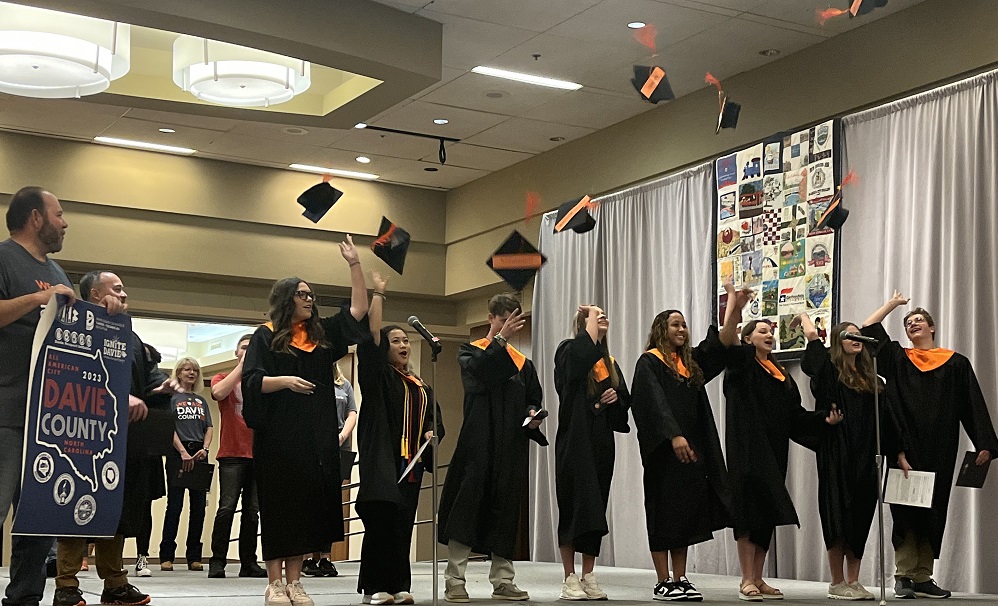
Real-world outcomes include student-designed solutions implemented by major employers (e.g., a drafting student’s mattress racking system adopted by an Ashley Furniture plant). Students also compete and place in state/national contests (SkillsUSA; FFA). CTE is visible in the community through parades, volunteer events, a campus Car & Tractor Show, and Careers on Wheels for early career exploration.
Engagement Strategies:
- Employer partnerships, facility tours, and work-based learning (internships/apprenticeships).
- Teacher externships to align classroom content with industry practices.
- Middle-school career exploration, high-school CTE pathways, and dual enrollment via CCP.
- On-site, hands-on labs with industry-standard equipment.
- Community events that connect families, students, and employers.
Outcomes:
- Participation: 71% of DCHS students take at least one CTE course.
- Credentials: 1,927 industry credentials earned (2021–22) → #4 in NC for credentials earned based on potential; Top 10 by percentage based on enrollment.
- Graduation: Overall DCHS graduation rate 87%; CTE Concentrators (2nd-level course) graduate at 98%.
- Representation (CTE overall): Participation rates roughly match school demographics; females underrepresented by 9.5%; Hispanic +0.5%; African-American −0.92%.
- Representation (CTE Concentrators): Females 36.9%; Hispanic −0.6%; African-American −3.7%; White +4.9%.
- Program breadth & relevance: Added CCP pathways (nurse assisting, emergency services, firefighting) and new advanced manufacturing equipment to meet employer demand.
- Student distinction: National/state contest placements; internships yielding tangible employer value.
- External validation: State Superintendent cited DCHS CTE as a model for North Carolina.
Resources
Explore More Innovations From Communities Across the Country and Down the Road
See All ProjectsThank You to Our Key Partners