By Eve Sullivan
Introduction
Does a family function as a democracy? The United Nations asserted this, proclaiming 1994 the International Year of the Family – designating May 15th International Day of Families – and calling “the family: the smallest democracy at the heart of society”. Ask any teenager that question, however, and the answer you will probably get is a resounding “No, it’s more like a dictatorship.”
The right answer, I trust you will agree, is both yes and no. Most families have democratic elements and dictatorial elements. In happy, healthy families, parents manage to balance the two, or at least keep those elements in some semblance of equilibrium, modifying them, often on the fly, to meet their child’s or teenager’s developmental capacities and needs.
 The wonderful logo created for the International Year of the Family, designed in a brushwork style, shows a heart within a heart under a roof. For me, this image captures the essence of parenting and, at the same time, the essence of parenting education, the subject of this article.
Framing the discussion
The National Civic Review and you, its readers, look for “insights into ways of strengthening democratic institutions.” In this article, I argue that parenting education must be put near, if not at, the top of local, state, and national policy agendas if we are to effectively face the many challenges to civic well-being recognized by community leaders. These challenges are evident in every arena: the workplace, education, housing, libraries, health care, faith communities, social services, youth programming, and senior services, and the fields of law enforcement, criminal justice, juvenile justice, and adult rehabilitation.
The political realm should be added to this list, of course. Leaders at every level of government recognize that our skills and practices in civic discourse need significant improvement.
I will briefly describe what parenting education was in the past: primarily nutrition and sanitation instruction for low-income and immigrant mothers; what it is now: a cascade of books, podcasts, and social media streams that, more often than not, confuse and discourage parents; and what I see parenting education becoming.
Parenting education is a powerful way to support children and young people—by supporting their parents—in developing the healthy relationships and positive behaviors that underlie individual life satisfaction and success, as well as community vitality. With peer support at its core, parenting education can serve to interrupt intergenerational transmission of trauma. It should and can be made available, accessible, affordable, and attractive to all parents and caregivers in a variety of settings across the lifespan.
I believe that making parenting programs—with their emphasis on listening, conflict resolution, and shared responsibility—the cornerstone of society, will greatly improve both individual and community life. In the process it can strengthen the foundation of our democracy.
A look back and a look around
Let me return to the memorable International Day of Families’ memorable logo. The image can be seen as depicting loving adults, the larger heart, protecting a child, the smaller heart, with the family’s home as a roof sheltering the individuals.
The image can also be seen as showing a supportive community, the larger heart, providing for a family, depicted by the smaller heart, with social structures (such as housing and employment) and social services (such as education and health) as a roof sheltering the community. Of course, these structures and services can also be called a foundation.
Using this bi-focal lens, let us look back over 150 years to the kindergarten movement. Kindergarten, which came to the U.S. in the 1860s, is universal today and its spirit animates initiatives to serve younger preschoolers. These include the Early Childhood Development Action Network (ECDAN) as well as local and state efforts to make early learning opportunities the norm for all children because of their significant life-long benefits. A notable 2023 development in advocacy for early childhood education is the Act for Early Years’ “Mini-Festo, a child-sized manifesto urging leaders to make big investments in the littlest children.”
Then consider the home economics movement. This grew from the Lake Placid Conference in 1899, where the term was adopted, and from Ellen Swallow Richards’ founding of the American Home Economics Association in 1909. The latter, now the American Association of Family and Consumer Sciences, serves high-schoolers, promoting curricula for both boys and girls in child development and child care as well as financial literacy, nutritional health, consumer awareness, and overall independence. These skills sound, to me, like what children should be learning at home.
Parenting then and now
For centuries, if not millennia, children learned how to be adults by being around their parents and other older family members day in and day out. Now? Young adults need courses in ‘adulting.’ I confess that I had to ask the internet where the term came from: it was coined by American writer Kelly Williams Brown in her 2013 book of the same title. But isn’t raising children to adulthood what parents are supposed to do?!
It seems clear that the adults presently raising the world’s children need some help. It is not that parents don’t want to do the work. But they are busy. Basic necessities are expensive, making work and commuting eat into family time. Societies are complex. The media—much of it portraying parents and family life in a very bad light—is overwhelming us and our families. A steady flow of parenting advice comes at parents in print and via digital media, some of it useful, some much less so.
Missing from the current picture is a formal social structure, or collection of agencies and organizations, that provide parents with the encouragement and guidance they need, when and where they need it. Program provision is a concern, but so is program participation. Sooner rather than later, we need a shift in social climate to encourage parents to take advantage of programs that are offered. Without increasing both provision and participation, we will continue to fall short in our efforts to create the homes and home lives that effectively support our children’s healthy growth and development.
There is stigma associated with parenting programs because they are mandated, as they should be, in cases of child neglect and maltreatment. We need civic leaders in all sectors to bring parenting education out of the shadows. Parenting education is a public good: a basic preventive investment in healthy community life.
A parenting education case study, part one
Before I get back to my main argument, that parenting education is an essential social service, I want to make an important digression. My boys’ teenage years were challenging. Without getting into specifics, the support available to one of my sons, his father, and I in the late 1980s was much more harmful than helpful to him. I came out of that difficult experience, however, having benefited immensely from the parents’ part of the program: I learned the value of emotional awareness and acquired practical skills for expressing feelings.
Trained as a language teacher, I realized that I could write a curriculum to teach emotional awareness to others. My hope, in founding Parents Forum in 1992, was to spare other parents and their children some of the struggles that I and my family experienced. With the help of many individuals and modest support from a few funding organizations, I have, as a volunteer, kept the program going for thirty-plus years. In the process I have become a committed parenting education advocate and part of a national and international network of parenting educators.
One stand-out among the resources from this network is Dr. A. Rae Simpson’s 2001 “Raising Teens: A Synthesis of Research and a Foundation for Action.” Unfortunately, her recommendations have not been as widely implemented as they might have been, judging by recent reports from the Pew Research Center and the U.S. Surgeon General. Sadly, we have made little progress in the last 25 years in providing parents with what they need as parents.
Even though the support I got came a bit late, we made it through. I am grateful to be in good touch with all three of my grown sons and their families, especially my four wonderful grandchildren who give me hope and joy. Further, the friendships and regular contact I have with my sister and brother are as important to me as my relationships with my adult children. They help me get perspective on some unhappy childhood experiences. Keeping in mind that process of “interrupting intergenerational transmission of trauma”—long words that mean, basically, letting go of the past—let’s examine the nuts and bolts of parenting education.
What effective parenting education is
Parenting education has three main elements: cognitive, behavioral, and emotional. Parent peer support is a through-line in all effective programs, since most adults learn at least as much, if not more, from others with similar experiences as they do from authorities or experts.
Parenting education…
- provides information about both child development and appropriate expectations for each developmental stage
- models and encourages behaviors and speech that effectively support and guide children at each stage of their development and that develop parents’ problem-solving and leadership skills
- offers emotional support and social connection.
While parents need all three elements throughout their children’s development and into adulthood, these map well onto the three main phases of childhood:
- From a child’s birth to age five, parents need more of the cognitive element. Infants, toddlers, and preschoolers are learning to eat, sleep, walk, talk, and toilet. Ideally parents speak, sing, and read to their children at every opportunity.
- During elementary school, parents need more of the behavioral element. Children ages six to ten are learning to manage their behaviors in school and out, to be part of a team and to get along with friends. In the best cases, children learn to do these things by imitating their parents. (We need to be on our best behavior as much as possible.)
- When a child enters adolescence, parents’ focus needs to shift to the emotional and social realm. ‘Emerging adult’ children need parents’ encouragement more than their guidance as they move toward independence. Because adolescent behavior involves some risk-taking, parents may, too often, use a heavy hand. It can be a rocky time.
Let’s look next at how parenting education relates to various sectors of society. Some civic leaders champion programs that serve parents well, but the provision/participation conundrum remains a sticking point.
Parenting education in various social sectors
The world of work
Business leaders acknowledge that employees and businesses themselves can benefit significantly from courses in managing interpersonal issues. The Society for Human Resource Management’s delightful public service announcement “When I grow up” made this clear.
The workplace is an ideal venue for parenting education programs. Putting these on the menu of HR skills development offerings normalizes both their provision and participation in them. Perhaps most important, offering parenting programs at work makes them available and attractive to fathers. Civic leaders can encourage employers, employee associations, and unions to offer parenting education in order to promote social and emotional skills throughout the workforce.
Education
School programming focuses primarily on children, as it should. Some notable initiatives, including Harlem Children’s Zone, founded in 1970, and the state of Minnesota’s Early Childhood and Family Education (ECFE) program, initiated in 1983, bring the benefits of parenting programs to their work with children. The sad reality is that when school districts offer parenting programs, they may find few participants. On the other side of the coin, parents may express a need for support but not find it.
The National Parents Union, organized in 2020, does remarkable grassroots organizing. A recent success is its support for literacy reform with the Reading Excellence and Achievement for Development/READ Act. NPU supports individual parents and parent groups and does an excellent job engaging fathers, who are too often ignored in the parenting education world.
Housing
Many public housing developments, and some commercial ones, organize both social activities and social services. There are many examples of organizations engaging residents where they live, showing that provision of parenting programs in residential settings can increase participation in them.
Libraries
A small fraction of public libraries now have social workers on staff. Parenting education, professionally led or peer-led, would be a natural supplement to book readings and other activities for adults and young people.
Health care
Since most parents take their children for regular checkups, doctors and other health care providers are well placed to urge parents to sign up for parenting education programs. The National Academy of Medicine’s Collaborative for Healthy Parenting in Primary Care, by its name alone, clearly favors helping parents get and stay on track.
The CDC finds that “adverse childhood experiences (ACEs) are common and can have lasting, negative effects on health and well-being.” The agency stresses that these experiences and their associated harms are preventable. Among the recommendations it offers parents is to seek parenting skills training programs to help build stronger relationships with their children.
Faith communities
Pastors and other faith leaders, like health care providers, have positions of authority and are often called on when family problems arise. Engaging the religious community in advocating for parenting programs would go a long way towards the goal of normalizing parenting education.
Social services
Many social services focus on problems—remedial programming will always be needed—but family resource centers and other agencies in many communities already offer positive, preventive parenting programs. These will benefit greatly by increased support and publicity.
Youth programming and senior services
Most youth sports organizations require an orientation for parents before their children begin team play. Lessons on good sportsmanship and appropriate cheering behaviors could be enhanced by referrals to parenting programs for all parents. Let’s add arts and music organizations to those that can refer parents to local parenting education resources. Senior services address issues of loneliness and isolation among older people. Opportunities for those who have raised their children to support those who are actively parenting can benefit both.
Promoting parenting education in programs for youth and for seniors, as in the workplace, education, housing, and elsewhere, will effectively reach parents where they are and serve to lessen the stigma that inhibits participation.
Law enforcement and criminal justice
The police department in Cambridge, Mass., where I live, has a social work response team that handles situations that could be escalated by the appearance of armed officers. Another well-established local initiative is Strategies for Youth, giving young people guidance on interacting with officers.
Could we reduce the need for problem-focused programming by offering positive and preventive parenting programs across the board, promoted through law enforcement and criminal justice? The prison work that I have done with Parents Forum tells me that the answer is yes. One inmate at MCI-Norfolk (Massachusetts) who participated in Parents Forum shared this with us: “This program is on a level that a 15-year-old can understand. This program can be a solution. This program gives hope!”
Politics
It is news to no one that our political landscape is fragmented. Many local and national efforts bring people together across various divides, including Listen First, focused on healing toxic political polarization and restoring social cohesion. Politics often divides families. We need bridge-building on both the personal and the community level.
A parenting education case study, part two
Many excellent parenting programs are long-established in the US, like Strengthening Families, founded in 1982, and a program that it fostered, BeStrongFamilies, which organizes Parent Cafés focusing on peer support. Some are newer, like Parenting for Lifelong Health, based in the U.K.
Now let me describe Parents Forum, the program I know best. Parents Forum is an evidence-informed program that helps participants develop emotional awareness and improve communications and conflict management skills. A participant in a recent online session wrote, “This workshop isn’t just about communication—it’s a pathway to more honest, connected, and meaningful relationships.”
“How to tell somebody something they’d rather not hear,” our mini-session offered for free online, is the cornerstone of Parents Forum’s nine-question scripted curriculum, designed to be peer-led. In a small group, participants describe household or workplace annoyances—or situations in community spaces like re-claiming one’s place in line at a deli—or more serious issues like firing someone, quitting a job, breaking up with a partner, political differences, or addressing behavioral concerns such as alcohol and other drug use, eating disorders, or mental health issues.
With the facilitator’s help, a participant practices a ‘wrong-way’ confrontation, then finds a better way using the Parents Forum conversational formula. Participants describe the situation, along with their feelings and the positive value that the problematic behavior ignores, then present it dramatically. The session gives participants strategies and energy for addressing challenging situations in both their professional and personal lives.
In 2025 Parents Forum adopted a new logo, which received a Graphic Design USA award in the category “health and wellness.”
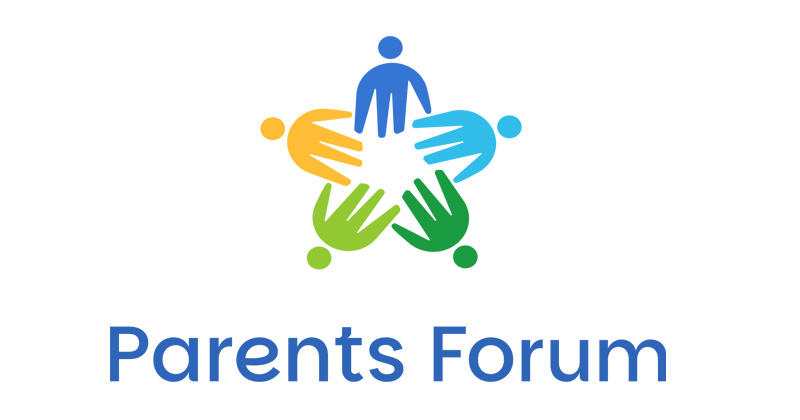
Like the U.N.’s IYF logo, the Parents Forum logo has a double meaning, representing both people and hands. People in a circle represent Parents Forum’s fundamental belief in the power of peer support. The hand shapes refer to the program’s Handy Guide, one of Parents Forum’s Tools of the Trade.
I invite you to write a short letter supporting Parents Forum’s proposal to the United States Postal Service to create a stamp honoring parenting education. Parenting education is not just ‘would-be-nice-to-have’. It is essential! We believe it meets USPS criteria that stamps honor enduring contributions to American society on a theme of widespread national appeal and significance.
Parenting education matters to democracy
Parents Forum’s 1992 letter requesting nonprofit status said in part:
“Our program suggests that despite good intentions, many parents are unable to provide effective guidance for their children, especially during the often turbulent period of adolescence. Our program organizes opportunities for such support to be given and received before a crisis occurs—before even any trouble appears on the family scene.”
Even the IRS recognized the importance of this issue, sending our 501(c)(3) determination within six weeks: record time. Now we need you, leaders of our cities and towns, policy makers and practitioners, legislators and governors, to take up this cause.
The National Parenting Education Network (NPEN) provides messaging on the topic, as does this blogpost for the Global Initiative to Support Parents (GISP), part of the Early Childhood Development Action Network.
I urge you, and fellow leaders in your community, to start planning an inaugural summit on parenting education to bring together leaders in all sectors. Make it an annual event. Your gathering could be held May 15th International Day of Families, June 1st Global Day of Families, August 1st Respect for Parents Day, or on National Parenting Education Day, the first Friday in April.
What we learn at home from our parents, as they do their best to love us, encourage us, and guide us, determines the kind of citizen we become. Parenting affects the function of democracy. As a society we need to make parenting education a top priority now.
Eve Sullivan is the Founder and Board Chair of Parents Forum