By Doug Linkhart
“Engagement is embedded in everything we do as a city.”
Mary Bunting, Hampton City Manager
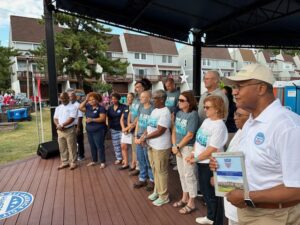
Hampton, Virginia, has long been recognized as a leader in civic engagement, with such efforts dating back to the mid-1980s and being particularly exceptional in resilience and sustainability. Hampton is a five-time All-America City Award winner, demonstrating that it is never content to rest on its laurels. The development of Hampton’s culture of engagement was guided by the basic premise that government cannot, and indeed should not, solve all community issues on its own, and a belief that better results come when residents are part of the solution.
Hampton is a city of just over 130,000 people, half of whom are Black, with a lower-than-average poverty rate of nine percent and an above-average homeownership rate of 55.6 percent. Situated at the mouth of the Chesapeake Bay, Hampton is part of the Hampton Roads region, which encompasses Norfolk, Virginia Beach, and Williamsburg, with many residents traversing the area for jobs or other needs.
“Hampton is the envy of the East Coast,” said Vice Mayor Steven Brown, referring to its diversity and wealth of assets such as the NASA Virginia Air and Space Museum, extensive waterways,  Langley Air Force Base, and great colleges. “This city is very, very resilient,” he added. “You know, slavery started here. It also ended for many here.” (Hampton’s Fort Monroe is on the site where the first enslaved Africans arrived in 1619. During the Civil War, the Union-held fort was a refuge for escaped slaves.)
Other assets include universities that are either in Hampton or nearby, including Hampton University, William & Mary, Old Dominion, and Virginia Tech. With many beaches and historic sites, the city and Hampton Roads attract tourists from elsewhere in the state and beyond.
With a wide range of community engagement programs, Hampton has repeatedly won the All-America City Award by showing the results that stemmed from those programs. As outlined in this article, the city has reduced its crime rate, improved educational performance, improved climate resilience, gained public support for both budget cuts and increases, and generally maintained relatively good economic prosperity over the years, largely as a result of the “Hampton Way.”
I – Community-Centered Participation
Civic engagement is so embedded in city problem-solving in Hampton that it has been called the “Hampton Way” and is now widely known in public administration circles. From budgeting and land use to climate and cultural planning, thousands of residents—from teens to older adults—are regularly engaged in shaping city priorities. Whether through neighborhood commissions, multilingual town halls, or digital outreach, Hampton’s co-creation ethos ensures that residents not only have a voice but actual influence.
Beginning in the 1980s, the city has created a variety of mechanisms for institutionalizing civic engagement. Early on, City Manager Robert O’Neill’s experience with problem-solving processes for neighborhood issues led the city to create a Neighborhood Office with skilled facilitators that worked side-by-side with existing and emerging leaders to help convene residents to develop neighborhood plans and oversee rezoning and other development processes.
The city’s most well-known and honored engagement effort is its annual budget input process, I-Value, which was started in 2010 by newly appointed city manager, Mary Bunting. During that year, the city faced a daunting budget shortfall. With $20 million worth of cuts to be made, the I-Value campaign asked residents to weigh in on what services were most important to protect and which they were willing to cut.
During community budget conversations, residents were asked to think about the city budget much as they would a household budget, rating services according to which were “needs” and which were “wants.” Recorders transcribed resident input and printed it out to share with residents before the end of each meeting. Meeting results were published online and shared with the council, outlining where the majority of Hampton residents thought cuts should be made.
In 2014, after years of reduced service levels, the I-Value process was successfully used to gauge the community’s sentiment to raise taxes to avoid further reductions. Residents were asked whether they would support an increase in property taxes and if so, by how much and for what purposes. At the end of that year’s engagement, nearly 90 percent of the public expressed support for a significant tax hike. With this high level of documented public support, the council raised the mill levy with little opposition. All City Council members up for reelection the next cycle comfortably won, establishing the true value of the process.
I-Value has been used every year since its formation. Input opportunities each year range from small coffee talks to larger sessions in each quadrant of the city, with immediate polling and results, generally resulting in input from close to 3,000 people. There are also sessions on Facebook Live with questions and answers and an online poll.
“The reason I-Value works—or, frankly, any of Hampton’s engagement efforts have worked—is that people fundamentally want to be a part of the decisions that impact them. Engagement never guarantees that everyone will be happy with the result,” said Bunting. “That utopia doesn’t exist. However, engagement does produce better decision-making and, more importantly, better feelings about the process used to make decisions. When residents know they have a choice to make and how to influence decision-making, they inevitably feel better about it.”
All in all, Hampton has sixty-two active boards and commissions made up of residents and business owners, totaling 457 seats. Recent data on these participants indicates that 47 percent are Black, 43 percent White, two percent Hispanic, one percent Asian, one percent Native American, and four percent “other,” which roughly matches the city’s population. The gender mix is evenly split and the distribution by age shows 15 percent are under thirty-three; 33 percent are 34-51; 47 percent are 52-71; and six percent are 71 and up.
Much of this progress is due to the work of Mary Bunting, who joined the city staff in 1989, logging 36 years as of this writing, including 15 years as city manager. Bunting was raised with a civic conscience, born to a mother who was a social services director and later a city manager herself, in Roanoke, Virginia, also a repeat All-America City winner.
Her mother, Bunting said, taught her and her siblings “an orientation of communal service generally. It wasn’t like she wanted us to go into local government per se, but she wanted us to have a community spirit at heart and mind. And she was a single mother and that meant that we had to go to council meetings instead of watching cartoons—and people think I’m joking.”
Although Bunting originally intended to go into international relations work, she was convinced by area city managers Jim Oliver from Norfolk and Bob O’Neill from Hampton to attend the Maxwell School of Government at Syracuse, after which she did a fellowship in Phoenix, eventually coming back to Hampton when an assistant city manager position opened. And when an offer of a position as city manager for another city arose, it was O’Neill, Bunting said, who helped her decide to stay in Hampton, a place where, she said, she would be “happy and fulfilled.”
Another champion of civic progress and engagement in Hampton is former Mayor Donnie Tuck. First inspired by the words of President Kennedy while he was in the first grade, Tuck served six years on the City Council, after which he served another eight and a half years as mayor, after which he was succeeded by Jimmy Gray in January 2025. One of the reasons he first ran for office, Tuck said, was that “I felt like my Chapel Hill, NC, neighborhood was neglected. We had dirt roads, and my parents and my neighbors would sign petitions every time they heard the city was doing something in other neighborhoods. Instead, those streets never got paved until after I had moved away at age 25.”
“I think Hampton’s a special place,” added Tuck. “One, it’s historic. But other than that, I think it’s the people. It’s really the people that make a community. The residents love the city and want the best for their communities. And in fact, at the time that I was running initially for the council, there were so many neighborhood organizations. There were a lot of people who would come to the council meetings to get them to address their issues. I think that was one of those things that made it special to me.”
One of Tuck’s initiatives was the Macedonian Call, a group of faith leaders who meet with the mayor and city officials quarterly to talk about common concerns. The group, which includes ministers, preachers, rabbis, and any others who might be interested, often generates ideas and resources to supplement city work on particular issues. A more formal working group of the leaders is FaithWalk, which can often implement ideas that arise during the meetings.
An example of work by the faith groups, as described by Mayor Gray, is “our talk about homelessness or lifting people out of poverty or violence. They might run workforce development classes and do things like help get clothing for people if they need professional dress. We might teach the certification that the person needs to go get a job, but we can’t provide all that extra stuff. But then the faith-based leaders come in with us, and they provide those extra things, so together we really help to lift that person out of poverty.”
Engaging young people in civic affairs is a major priority of both the city and school district. The city’s Youth Commission oversees a small-scale grant program that funds community-based and school-based youth projects. Through the commission, young people also learn skills for making a difference in their schools and neighborhoods. Both the Neighborhood and Youth Commissions have been developmental grounds for the city’s leadership, both at the neighborhood level and citywide.
Beyond involving young people through the Hampton Youth Commission, the city also hires two high school youth planners each year for the Planning Office, and they work with the Youth Commission, which also plans events and gets input from peers. In addition, the city’s Unity Commission has a separate Unity Youth Commission, and the city’s School Board has two slots for students, who contribute but can’t vote. Overseeing youth involvement is the city’s Department of Youth and Young Adults, which depends heavily on peer-to-peer conversations to understand issues affecting young people.
“The younger generation,” Bunting said, “is more connected digitally as opposed to personally. A lot of young people know more people throughout the world than they know in their own neighborhood because of these devices. The challenge is how to get new civic leadership in neighborhoods and get young people to understand that that’s critically important. One of our youth commissioners said recently that you can’t just leave this to the older generation to run civic associations.”
The motto for Hampton’s school district is “One Community, One Transformation.” “We value our partnership with the city,” said Raymond Haynes, the local superintendent of schools. One recent collaboration, he recounted, involved groups of students who created a large turtle sculpture and then filled the turtle’s body with plastic they cleaned from waterways. The sculpture was installed at a city park to teach the public about the dangers of plastics to marine animals.
The infrastructure for ongoing cooperation between the city and school district was developed at the turn of the century when the city agreed to a funding formula for the district as a proportion of city tax revenues. The two parties also agreed to ongoing transparency and input on budget matters, with the school district’s chief financial officer serving on the city’s budget committee and a city representative serving on the district’s committee. Bunting calls this a “foundational experience that laid the groundwork for other cooperative efforts,” and a way of infusing collaboration between the entities that has lasted through “good times and bad.”
II – Collaborative Governance
The Hampton Way has been used in collaborations among residents, businesses, and the city to address a variety of goals and problems. “Collaboration is ingrained in our city’s culture,” said Mayor Jimmie Gray. “We collaborate all the time in Hampton, and I think that kind of makes us unique. People expect to be part of it, and we make sure to provide opportunities for them to be a part of our future. So, what we do is we apply the Hampton way to any problem or challenge that comes our way.”
Hampton’s first formal recognition of the need to engage its residents began in the 1980s when a proposed road development caused controversy in the community, spurring then-city manager Robert J. O’Neill, Jr. to bring residents together to find a compromise. The residents found consensus through conversation, inspiring additional engagement efforts.
An example of O’Neill’s collaborative approach to problem-solving was when the Old Northampton neighborhood wanted a community center for their youth to have a safe place to recreate and asked for money to convert a closed school into a neighborhood center. O’Neill recognized that the city would never be able to fund every neighborhood’s wish list; yet, if the city simply said no, it would undo the goodwill developed through the citizen engagement work to date.
O’Neill offered residents a compromise: the city would renovate the old school into a neighborhood center if the neighborhood would commit to staffing it with volunteers. The residents accepted the challenge and, a few years after the proposition, the Y.H. Thomas Center opened. Decades later, the center is still operating, and its attendance surpasses that of every other community center in the city. The center is still largely run through volunteer commitment, and city leaders believe it is this volunteer spirit that has made the Y.H. Thomas Center the most actively used city facility. The neighborhood has a true sense of ownership; residents are fully invested in its success.
Bunting calls these kinds of partnerships a “model of co-creation that really works beyond just providing city services,” citing the Y.H. Thomas Center example. “We ask ourselves every day, you know, what can we uniquely do, what other people are better able to do, and how can we put those things together. So, it’s not a government-led solution, it’s a community-led solution.”
Recent examples of collaboration include the city’s work on short-term rentals and homelessness and the creation of a new comprehensive plan. Short-term rentals, such as Airbnb, have drawn criticism in many cities because of side effects such as noise and extra cars using available parking. In Hampton, Mayor Jimmie Gray said that by reaching out to landlords and neighborhood residents and holding a series of meetings over many months to discuss problems and solutions, the city was able to find a middle ground between those who didn’t want any rentals and those who believed they should be unregulated—with a set of regulations that, when adopted by the city council, attracted almost no opposition.
Regarding homelessness, Gray said, “we had many complaints from the business community about it, and we had citizens who were calling and complaining about people sleeping in the space. We created an advisory committee to work specifically on this issue, and they came back to us with recommendations about what ought to be the model ordinance. And they’re still working on this right now.”
The city recently revised its comprehensive plan, a process that included input from nearly 3,000 volunteers drawn from residents, businesses, non-profits, educational institutions, healthcare institutions, and many others, developing the following vision statement:
We are Hampton, a vibrant waterfront community, celebrating and embracing more than 400 years of history and innovation, to create an even more dynamic future.
Public safety partnerships have been a key in addressing crime in Hampton over the years. The city was an early practitioner of community policing, which began in the 1970s with neighborhood watch meetings, training for officers in community relations, and regular meetings with residents.
More recently, the police department is engaged in a variety of community engagement efforts. For example, in 2021, the city created a Public Safety Collaborative to address youth and young adult violence, bringing together schools, juvenile services, the Commonwealth Attorney’s Office, police, social services, and the regional mental health agency. The collaborative developed a vulnerability list of youth and young adults who are most likely to be victims or perpetrators of crime based upon risk factors. Working with a list of 50 to 100 at a time, the collaborative provided resources to prevent and divert violent behavior. With this program showing success, the city is working to create a similar approach to addressing domestic violence.
III – Outreach and Targeted Work to Address Disparities
Hampton’s work to improve equity began decades ago.
“I think the reason why we fare a little bit better than some of those is because of our really deep roots of engagement,” said Bunting. “And also, frankly, not that we’ve been perfect on racial equity issues, but Hampton has done some things that others didn’t like when it came to integration of schools. Hampton voluntarily integrated versus having to be forced to do it. So, we have a little bit stronger relationship as a government and a school board with our African American community than some others do. And again, not that it’s perfect.”
The city works hard to honor diversity and improve equity. The City of Hampton Diversity, Equity, and Inclusion Office conducts targeted outreach to communities that may not feel connected to city programs and opportunities. That has included co-sponsorship of events, such as Iftar dinner observing the end of Ramadan, Hispanic resource center, an Egyptian/Coptic festival and congregation, the LGBT Life Center, and a family-oriented Pride Day. Movie Talks screens popular films and hosts a lively community discussion that uses the themes of the films to relate to diversity and cultural awareness. The free movies draw good crowds, including children—often those who can’t afford to see first-run films at the theater.
One large health equity initiative in 2024, a free wellness expo geared specifically toward Black women of all ages, offering awareness of breast and other cancers, reached full capacity at the convention center. DEI staff also conduct extensive training with public health officials, focusing on how to work more effectively with residents of different socioeconomic levels, different genders and orientations, and different cultural backgrounds.
DEI staff also takes recent police academy graduates into neighborhoods to engage with residents. They knock on doors and talk to people on the street in a casual way. They also visit higher-crime areas and traditionally underserved neighborhoods to build connections and trust.
With a two-person staff, the DEI office often works through the 19-member Citizens’ Unity Commission, which was created in 1995. That body is composed of diverse leaders who have reach and influence in all segments of the community. The 20-year-old Diversity College program now has 2,000 graduates who have developed a greater understanding in areas such as race, ethnicity, culture, disabilities, generational diversity, gender differences, LGBTQ awareness, world regions, social justice, equality, equity, socioeconomic status, culture, body size/image, and inclusion.
 One example of diversity work related to public safety is a partnership with the Aberdeen neighborhood, in which the neighborhood hosts new cadets each year to help them learn about their neighborhood and generally about the African-American experience with police, so they can have candid conversations and the police officers can learn how best to approach and be received well in a neighborhood.
IV – Measurable Progress
Sustainability projects in Hampton have led to outcomes such as less flooding and revitalized communities in Aberdeen, Phoebus, and neighborhoods more generally.
An area with quantitative success is community engagement to improve local schools.
“We did a whole collaboration around schools and changing them,” Bunting said. “Our schools were like 40 percent fully accredited, then after we did the transformation, they’re now, and have stayed 100 percent fully accredited without conditions.” (Accredited schools are those that are evaluated by independent organizations and found to meet certain standards.) “And we have the lowest dropout rate of all the urban localities in the area, and like the second lowest dropout rate,” she added.
These results have come despite a school population with many at-risk students. Mayor Gray pointed out that the “overwhelming majority of our students” qualify for free or reduced-price lunch programs, “yet we’ve got some of the highest graduation rates in the state. We’re graduating students from the new dual enrollment program, graduating from Community College, graduating high school.” Bunting added, “I think we are a good model for that because we’re a majority-minority city. We’re very much like, you know, we call these in Virginia, we call them Virginia’s first cities, the core cities that have sort of core demographics.”
A large part of the credit for improvements in school performance is due to the Hampton Academies program, after which, said Bunting, performance numbers skyrocketed. “The graduation rate shot up significantly, on-time graduation rate, in particular,” she noted. “Dropout rates went way down. We’re actually one of the top-performing schools in the state now. Families that were choosing private schools are returning. So that collaborative was completely transformational and collaboration at a whole different level.”
Another area with successful outcomes is public safety. Since 2012, crime has dropped from 11,706 incidents to 9,642 in 2024, a decline of over 17 percent. The city’s website proclaims that “while no community is crime-free, the City of Hampton maintains a crime rate that is well below the national average for a city of comparable size. Additionally, Hampton’s crime rate is far below the averages for other cities in the Tidewater area.”
“Our crime rates have been higher than desirable in recent years,” said Bunting. “We’ve brought them down significantly because of our concerted attention. We did a whole collaboration around reducing violence, and when we started, we had a goal of reducing violent homicides or non-fatal shootings by 50 percent in five years. And we did it in a year and a half through our collaborative efforts with the community and all of that.”
While homicides have dropped considerably, crime rates edged upward in 2025, with most of the increase coming from escalating domestic violence and an overall increase in assaults nationally.
Regarding less tangible outcomes, Bunting feels that the city’s engagement efforts have also improved trust and voter participation. But, she said, “I think the biggest sign is a community progressing? Are the community indicators getting better? Is there stability or chaos? But I think trust comes from success, you know? And so, if you then go down to the programmatic level,” Bunting said, “like what are the key measures of a healthy city and are those moving in the right direction, that’s where you really get your answer about success.”
Hampton’s community spirit shows in the turnout for local festivals and celebrations, along with the engagement of so many residents in boards and commissions, neighborhood councils, cleanup efforts, and support for schools, along with their support for the city’s taxing requests. And as for the measures of success that Mary Bunting suggests, the community indicators, the city is showing results, maintaining its edge as an All-America City.
Doug Linkhart is President of the National Civic League.