By Melinda Burrell, D.G. Mawn, and Becca Kearl
“We wanted to avoid the next ‘mask-gate.’ That’s why we joined this project, out of a desire to build better relationships and communicate better,” explains a public high school communications director in Scottsbluff, Nebraska, about a project to help schools and their communities have more constructive conversations.
Fast forward eleven months to the end of the project, when the Nebraska team held a school board session. At issue: a controversial grading policy that had parents in an uproar. Using what they had learned, the Nebraska communications director and her teammates created an agenda that involved teachers presenting their views and every parent having the opportunity to ask any question they wanted. After a thorough and respectful discussion, the measure passed easily to applause.
“It really built trust, and there was NO negativity at the meeting. In fact, the one particularly demanding ‘frequent flyer’ parent had only positive things to say afterwards,” the communications director said with a smile.
Origins of the project
The project is a collaboration between the National Association for Community Mediation (NAFCM) and Living Room Conversations (LRC). NAFCM is a network of more than 400 community mediation centers across the continent. Living Room Conversations is a leader in the bridge-building field with tools to foster connection and understanding.
In 2021, several community mediation centers asked NAFCM for help with rising tensions in school communities. NAFCM connected with LRC, a new partner, and suggested co-creating a toolbox to help communities rebuild trust and have constructive, rather than destructive, conversations around education issues. In doing so, the organizations drew on their experience assisting even bitterly divided communities to create communication processes that help people listen to each other, build trust, and jointly solve problems. The toolbox included tools designed to be used in partnership between a community mediation center (or other skilled local peacebuilding/conflict resolution organization) and a school district. Tools included a stakeholder mapping matrix, a customizable template for holding community listening sessions, conversation guides, tips on “bringing people to the table,” and other tools.
With support from the American Arbitration Association (AAA– ICDR), in 2023-2024, NAFCM and LRC piloted the toolbox in five communities across the U.S.: Savannah, Georgia; Cincinnati, Ohio; Scottsbluff, Nebraska; Warrenton, Virginia; and Mount Vernon, Washington. Teams were led by community mediation centers and included representatives of the school district/school board or an education advocacy group. To maximize project learning, not only were the five teams chosen from a range of geographic locations, but they also were a mix of urban and rural communities with different degrees of existing relationships between the community mediation center and their school/school board.
Design of the project
To launch the project, NAFCM and LRC formed a learning cohort of all five teams. They held two initial trainings on the use of the toolbox that were followed by monthly virtual group meetings, enabling the cohort to share their experiences and support each other. NAFCM also held monthly individual check-ins with each team for tailored support. As one Nebraska community mediation center member articulated, “I like the accountability built into this project by the monthly meetings, with sending out agendas in advance, requiring a bit of prep work.”
There was a strong reflection element to the project, not only in the monthly meetings with the participants. The steering committee – NAFCM, LRC, and the program evaluator – met monthly to incorporate check-in information into the next monthly learning cohort meeting as well as the project overall. The steering committee sought to make those cohort meetings as responsive as possible to the needs of the teams, creating agendas based on what teams were struggling with at the moment (e.g., helping with messaging about the project to community members, issuing invitations to listening sessions, analyzing data from listening sessions, getting from listening sessions to actual policy change, etc.). Additionally, NAFCM and LRC built in two external project evaluations that used surveys and key informant interviews.
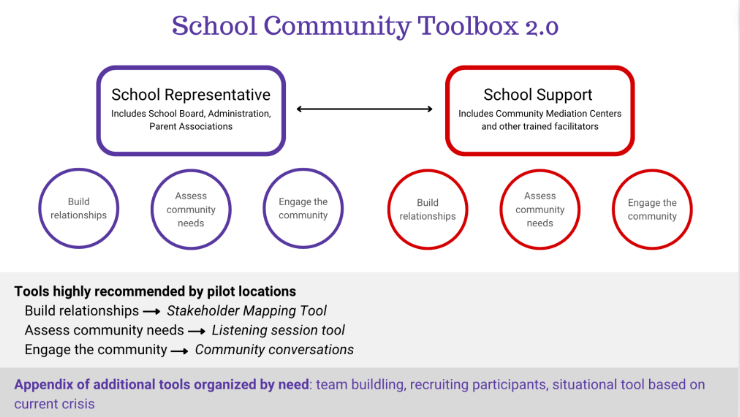
Infographic created by Mindy Burrell
After the training period, teams held listening sessions with parents, students, teachers, school administrators, and others to determine some of the main issues facing the school community. They then co-created action plans to address issues. “We don’t know what we don’t know [about our school community], but listening sessions helped us to gather information and then utilize what we learned to find the necessary lynchpin of change,” explained a member of the Washington community mediation center.
“This project essentially was a deep, rich conversation in a safe space,” said the Nebraska communications director. “A lot of the time, school districts will lead with thinking they have the solution. Because of our partnership with the mediation center, we were able to open up and consider what we don’t know.”
Impact of the project
The listening sessions revealed a lot of significant data, both about issues the school communities were facing as well as opportunities for growing relationships and instituting practices that would lead to further growth in the school community.

Photo courtesy of Gerring County School District
Most of the issues causing friction were related to school transparency and communication with parents.
“75 percent of what we heard about in the listening sessions were things that are already on our website, just not very accessible,” explained a Washington state school board member. “By making a few small adjustments, we were able to have a big impact.” The Nebraska team corroborated that finding: “Publishing the agenda builds trust more than I realized. We hear about it not when we’re doing it but when we’re not doing it.” In explaining to other principals how listening sessions meet district goals for community outreach, a Virginia high school principal exclaimed, “I was the star of the show!”
In addition to surfacing the issues that created disagreements, participants found that the listening sessions were important in and of themselves. This work increases community resilience. Evaluations by teams as well as the evaluator reported new or strengthened relationships, communication channels, and new peace-creation programs as a result of the project. The act of gathering people together for structured, facilitated conversations creates connections and deepens trust. As one Ohio team member noted, “We’re getting the idea of conversations out there. A lot of people were not as familiar with the possibility of a conversation as a way to build cohesion and trust but are eager now.” The Washington school board member articulated that point in this way: “We learned you can just try this one thing and see what happens. If it doesn’t work, at least we have tried something and will try again – and the community knows we tried and that still builds up community trust.”
What participating teams noticed
The teams learned a great deal from the project, both separately and then reinforced in their monthly cohort meetings. Lessons included the following:
- Be intentional and invest. Being deliberate about approaching other potential partners, spending time getting to know each other’s values, priorities, and constraints – even before starting the “work” of the project – is important. A suggestion was made to spend the “quiet time” of summer to start building relationships, and, importantly, to do so before a crisis hits. Schools’ default setting is to minimize risk and vulnerability, so building trust beforehand is important.
- Be vulnerable. Participants, particularly those from schools, learned the importance of overcoming defensiveness and mistrust, and instead suggested cultivating a mindset of openness and a willingness to change.
- Find champions. Having high-level administrators such as principals or board members, as well as strategically placed office staff, for instance, those working on communications, is crucial.
- Know your school system. Participants found value, as a first step, in researching whom to talk with in the school system for which issues, as well as understanding the rhythms of the school year. This knowledge helped teams identify best times and plan for activities such as relationship-building meetings, listening sessions, and strategy input.
- Fixing “little” things impacts many bigger things. Seeking changes in practices, policies, and procedures does not necessarily have to be a big lift. When the Washington team realized that much of the information that parents craved was already on their website but was not easily accessible, they were able to make some website tweaks that alleviated much of the problem.
- “You can always listen more.” Teams learned that there is endless benefit to listening carefully to a variety of sources. This holds for listening to community members during project implementation. This need to listen is also true for the partner organization(s) in your team as you build your relationship for smooth project implementation.
- Piggyback off existing school events and processes, such as parent-teacher conferences or holiday events. Look also to strategic planning processes or leadership transitions, community funding campaigns, and new federal or state legislation. Many school districts have state or federally decreed community engagement or continuous learning requirements to meet. Listening sessions or other processes suggested in the toolbox can help schools meet those requirements, which makes the school more interested in holding such sessions.
- Use the power of celebration. Teams found that school communities responded to positivity. More parents came to school board meetings when their children were being celebrated, and team members learned more after starting meetings with an acknowledgement of even small successes.
What we noticed
We, as well as the project participants, learned a great deal during our time together. Some of the most salient lessons from the perspective of organizations running the project were concerned with the importance of:
- Forming a learning community of the project participants, rather than having each team implement the project in isolation. The toolbox was helpful, particularly as a jumping-off point, but most helpful was creating the learning community of the five teams. The twin elements of all five teams sharing and celebrating together, as well as NAFCM and LRC modeling the concept of leading through listening, helped propel the project.
- A strong, existing school-community relationship. The teams most able to create lasting change were teams with some degree of a trusting relationship already existing between the school and the community organization. If the relationship is not there, then the first important step is to start building trust between the school and community through low-risk joint endeavors first, such as bake sales or sports days. Particularly in a project such as this, which is asking a school to invite feedback and create expectations of change, there needs to be a strong relationship of trust, respect, and mutual support.
- Fostering a culture of transparency. The project strove for systemic change, such as changes in laws, policies, or procedures. We found that, in addition to making those changes on paper, it was important to work with the school system to consider how to budget for, or otherwise resource, the changed policies. Without resourcing, the policy changes might not be implemented. Even more importantly, we found that culture change – fostering a culture of transparency and respect and intentionality – had a big impact.
- Meeting the general thirst for facilitated, structured conversations: In all five locations, teams found that people very much wished to talk to one another but also wanted to know if there were guardrails to keep the conversation constructive. “We had one session where a parent said they belonged to Moms for Liberty…She had different views which she expressed, and afterwards she shared that she thought this was the first time anyone listened to her views,” noted the leader of the Georgia team.
- Helping teams deal with conflicting information. Teams held a series of listening sessions with different segments of the community. This led to a situation in which some teams received conflicting information from different sessions. This is not an uncommon reality in today’s world. Therefore, teams need to think about and agree among themselves on how to handle the conflicting information.
- Follow-up listening sessions. While participants appreciated the sense of connection and deeper trust the listening sessions created immediately, evaluations noted there was something of a longer-range “so what?” aspect to the listening. As a result, the team, particularly the school system, needs to agree on how they will report what the listening sessions surfaced and how that information will be used.
Lasting impact
We learned of some broader project impact even after the project officially ended. The Nebraska team told us that, months after the project had ended, a school bond issue came up. The local farmers are normally not in favor of such measures, but they expressed to the team that they had realized how much stake they had in a healthy school community and voted for funding for the school.
Conclusion
This pilot project demonstrated that school communities can find their way back to constructive dialogue when given the right tools, structures, and support. The success of these five teams showed that the path forward is to be intentional in creating conditions for conversations to build, rather than destroy, community trust. Communities are hungry for exactly this kind of engagement: structured spaces where people can voice concerns, feel genuinely heard, and work together toward solutions. As school districts across the country continue to navigate divisive issues, this model offers a roadmap that starts with being vulnerable and admitting we do not have all the answers and moves to having the willingness to listen and perhaps change. Even more fundamentally, the roadmap is for a journey made with many, creating opportunities to reflect and celebrate with peers, partners, and community members.
Melinda Burrell, a member of the National Association for Community Mediation, writes, speaks, and trains on communication and conflict.
D.G. Mawn is president of the National Association for Community Mediation.
Becca Kearl is Executive Director of Living Room Conversations.