There’s an old adage that you should strive to leave the world—or at least the part of it you inhabit—better than you found it. It’s often applied to the environment, to camping, to the small corners of life we pass through and leave behind. But it’s just as good a rule of thumb for leadership. Doug Linkhart has lived that mantra for a decade, and earlier this summer he announced that his time steering the National Civic League is drawing to a close.
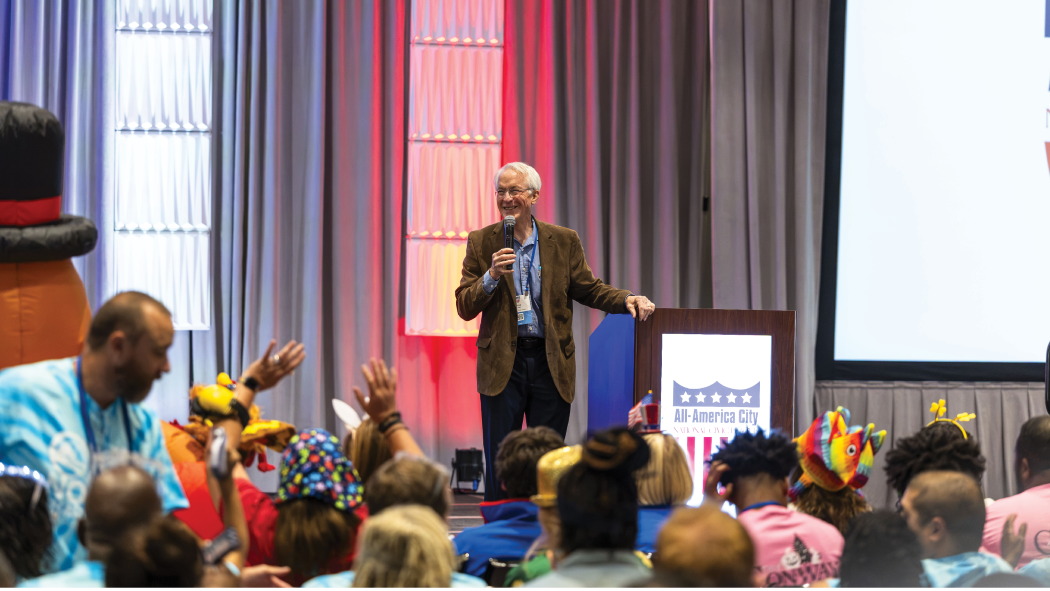 Standing before the crowd at the closing ceremony of the 2026 All-America City Award event, Doug shared the news that he will retire as President at the end of his current term in November. It was a fitting place to make the announcement: the All-America City program is the League’s flagship event, recognizing communities doing the hard, oftentimes thankless, work of civic engagement that has defined Doug’s own career for more than 40 years.
Doug joined the League on December 1, 2015, succeeding Gloria Rubio-Cortes. He arrived with a résumé few can match: 18 years in elected office, including eight years on the Denver City Council and ten years in the Colorado State Legislature, alongside stints as a neighborhood leader, federal employee, nonprofit director, and head of a 300-person city agency. He has, in short, worked civic engagement from nearly every angle it can be worked—as a resident, an official, an administrator, and an advocate.
That range shows in what he built at the League. Doug expanded the League’s reach and base dramatically. Staff grew from three to fourteen. The League opened its journal, database, and tools to the wider public, and brought the National Civic Review online, where it now reaches more than 130,000 readers. He guided the organization through the global pandemic—no small feat for an institution built around bringing people together in person—and came out the other side having modernized flagship programs like the Model City Charter, the Civic Index, and the All-America City Award itself. Most recently, he oversaw the League’s expansion into a Washington, D.C. office and its mergers with the Center for Democracy Innovation, Civic Genius, Local Policy Lab, and Spread the Vote, positioning the organization to strengthen democracy both inside institutions and alongside the residents they serve.
But ask the people who’ve worked alongside Doug, and the numbers aren’t what they’ll mention first. They’ll talk about his style: quiet, steady, and generous with trust. Doug has never been a leader who needed to be the loudest voice in the room.
“I’ve watched this play out from the board table for years,” says Patti Garrett,former Board Chairand longtime National Civic League board member and former mayor of Decatur, Georgia. “Doug never needed to be the one with all the answers. The Board knew that in leading the organization, Doug was also grooming other leaders with the National Civic League. He’d bring someone into a room, hand them something that actually mattered, and then get out of the way and let them own it. That kind of trust is rare in this work. It’s why the League has grown the way it has—not because Doug did it all himself, but because he built other people up to do it.”
That, in the end, is the throughline of Doug’s tenure. The League is stronger, broader, and better positioned to meet this moment for democracy than it has ever been. He leaves the world—or at least the part of it he inhabited—better than he found it.
The League will share more in the coming months about the transition and about honoring Doug’s legacy properly before his retirement in November. For now: thank you, Doug, for ten years of steady hands and generous leadership.