2026 All-America City Finalist – Stow, OH
When Revolutionary War veteran Joshua Stow first arrived in the area that would bear his name, he called it “one of the prettiest and most romantic spots in the Western Reserve.” Nearly 230 years later, Stow has grown from a small township into the third largest city in Summit County, with a population of nearly 35,000. That growth has brought both opportunity and challenge, including a historically limited civic identity, tensions around inclusion, and the ongoing work of building a community that reflects all its residents.
Stow’s recent trajectory reflects a city that has embraced transformation without losing its small-town character. The city has invested in landmark public projects, opened a new Community and Senior Center, expanded its park system, and pursued public-private partnerships that are reshaping underutilized spaces into cultural destinations. These investments are matched by an equally deliberate commitment to transparent governance and resident-driven decision-making.
The programs below reflect that dual commitment, using art and placemaking to build civic identity, modernizing land use planning through deep community engagement, and restructuring Charter review to ensure that foundational governance decisions are shaped by the broadest possible range of resident voices.
Public Arts Master Plan
For decades, Stow residents have voiced concern over a lack of a distinct identity and a traditional downtown. As a historically rural community that grew into a bedroom community, it had limited opportunity to develop the cultural anchors, destinations, and amenities that define a community’s character. When Mayor John Pribonic took office in 2018, he identified public art as a foundation for addressing that gap.
 The city reactivated its long-defunct Arts Commission, which launched several early initiatives including the Signal Box Art program, wrapping utility boxes at major intersections with artist-designed installations, and themed showcases highlighting women artists and veteran artists in partnership with local businesses. To build on this momentum, the city secured a grant from ArtsNow, Summit County’s arts advocacy nonprofit, to engage Sabertooth Public Art as a consultant and develop Stow’s first Public Arts Master Plan. The plan is being shaped through extensive public input gathered via the Arts Commission, Parks and Recreation Board, Commission on Inclusion, Senior Commission, community focus groups, event tabling, and a citywide survey.
Running alongside this planning effort is The Amp, a public-private partnership that will transform an underutilized commercial plaza at the city’s northern border into Stow’s first arts and entertainment district. The city will construct an outdoor amphitheater, install public art including a community-developed mural, establish a Designated Outdoor Refreshment Area, and open new trail connections. The private developer will simultaneously renovate the plaza exterior and bring three new local dining options. Construction on The Amp begins in March 2026, with an opening planned for summer 2027.
Zoning Code Updates
For years, Stow residents, businesses, and development professionals expressed frustration with a zoning code that was outdated, overly complex, and difficult to interpret. As the city prepared for future housing needs, environmental stewardship goals, and economic development opportunities, a full modern rewrite became necessary.
The update was designed from the start as a community-driven effort. An 11-member steering committee representing city council, the Planning Commission, the Board of Zoning Appeals, the Urban Forestry Commission, local architects, business owners, and residents guided the process. Public engagement extended well beyond required hearings. The city hosted workshops at the Stow-Munroe Falls Public Library, where neutral and accessible surroundings drew families, students, and residents unlikely to attend traditional government meetings. Open houses and educational sessions explained zoning concepts in everyday language, helping residents understand how regulations affect setbacks, tree preservation, stormwater management, accessory dwelling units, and neighborhood character. The city also deployed its Park Pop Up model, gathering candid feedback at parks, playgrounds, and community festivals from parents, seniors, and others who rarely participate in evening meetings. Online surveys complemented these efforts, producing thousands of data points that directly shaped the final code.
The resulting code, effective February 2026, modernizes environmental regulations, establishes a complete accessory dwelling unit framework, updates design standards, and reorganizes use tables for clarity and predictability. Residents report greater trust in land-use decision-making, and business owners appreciate the improved clarity.
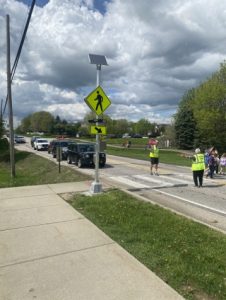
Running alongside the zoning rewrite, the city also completed its Safe Routes to School Travel Plan, and is actively pursuing grants for sidewalk construction, improved crosswalks, and safer student travel corridors.
Charter Review Commission
Stow’s history with Charter review had been marked by limited public participation and tension between commissions and city council. Previous commissions saw poor meeting attendance, and many recommendations were ultimately ignored by council. The 2025 Charter Review Commission set out to change that.
 Mayor Pribonic prioritized diverse representation from the start, appointing seven members reflecting a range of ages, genders, professional backgrounds, and political perspectives. Drawing on National Civic League training, commissioners consciously applied principles of deliberative democracy and civic assembly to their work. Over five months, the commission held 14 public meetings including two town halls and a work session with city council, donating more than 18 hours of meeting time alone. Proposed amendments were subsequently discussed across seven committee meetings and seven council meetings over three months, ensuring sustained public visibility throughout the process.
The commission proposed nine charter amendments and the creation of two new commissions, covering topics ranging from notice requirements and administrative continuity to council term staggering and ranked choice voting. City council ultimately placed two amendments on the 2025 ballot, both of which voters approved. Discussions around ranked choice voting and ward expansion continue, with the new council president expressing intent to revisit additional recommendations for the November 2026 ballot.
The process generated greater public involvement than prior cycles, and the conversations it sparked continue to lay groundwork for further improvements to local self-governance.
Some Related Posts
Thank You to Our Key Partners