2026 All-America City Finalist – Roanoke, VA
Celebrated as the Star City of the South and nestled in the Blue Ridge Mountains, Roanoke grew around industries like Norfolk Southern and Advance Auto Parts that sustained generations of families. As those industries closed or moved to larger markets, the city faced job loss, population shifts, the economic ripple effects of the COVID-19 pandemic, and declining civic trust.
Rather than turning away from these challenges, Roanoke has leaned into them. Over the past decade, local government, nonprofits, neighborhood leaders, artists, universities, and residents have linked arms across sectors to build solutions rooted in dignity and connection.
The programs below reflect that commitment, addressing homelessness through relationship-based outreach, strengthening the nonprofit ecosystem so community organizations can access and steward public resources, and using the arts as a catalyst for belonging and civic connection across neighborhoods.
Responding to Homelessness
Between 2023 and 2024, homelessness in Roanoke rose sharply, becoming visible across nearly every part of the city. Inflation, rising rents, and a limited housing stock placed mounting pressure on low-income households at the same time federal resources were slowing. The city recognized that issuing vacate orders that repeatedly displaced the same individuals to new encampments days later did nothing to address the underlying drivers: untreated behavioral health conditions, medical crises, job loss, trauma, lack of identification, and limited housing access.
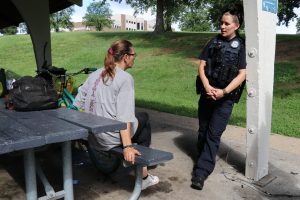 In January 2025, Officers Bri Dickerson and Jacob Underwood partnered with city leadership and service providers to launch STAR — Supporting Transition Assistance and Recovery. STAR is a coordinated, twice-weekly outreach model that brings public safety, behavioral health, addiction treatment, housing navigation, and nonprofit services directly into encampments. Partners include Blue Ridge Behavioral Healthcare, BrightView, the HOPE Initiative with Bradley Free Clinic, and The Least of These Ministry. Team members build relationships, help secure identification documents, connect individuals to medical and mental health care, and navigate housing applications. The city’s Homeless Assistance Team provides case management, housing voucher applications, and Welcome Home Baskets for those transitioning to permanent housing.
In its first year, STAR increased successful referrals, reduced cycles of repeated displacement, and shifted community perception, demonstrating that public safety and compassion are complementary values. In August 2025, Mayor Joe Cobb announced the Hope and Home Task Force, a cross-sector body analyzing root causes and developing long-term solutions. An early result is the Daily Express, a transportation route connecting the city’s largest overnight shelter to daytime services.
Engagement Ready and Grant Ready Roanoke
Many of Roanoke’s most committed neighborhood leaders were doing transformative work—preserving culture, mentoring youth, preventing gun violence, activating public spaces—without the administrative infrastructure to compete for public funding or manage it effectively. This gap became clear when community organizations that received American Rescue Plan Act funding struggled to navigate application and compliance processes. The passion was present; the organizational foundation often was not.
In response, the city launched Grant Ready Roanoke, developed in partnership with the Virginia Tech Institute for Policy and Governance, as part of the broader Engagement Ready Roanoke initiative. From a competitive pool of 20 applicants, 10 organizations were selected for the inaugural cohort, representing neighborhood associations, arts and culture, gun violence prevention, and public transportation advocacy. Two representatives from each organization committed to monthly classroom instruction and one-on-one coaching over six months. The curriculum covered governance, financial management, fundraising strategy, compliance, and board development. Equally important, it created space for peer learning, with leaders from different neighborhoods sitting at the same table, sharing challenges, and identifying opportunities to collaborate.
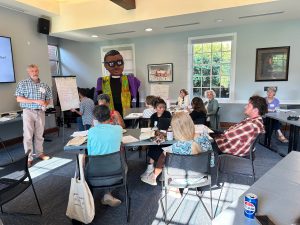
Nine of the 10 participants successfully completed the program. One organization obtained its 501(c)(3) status, another is navigating the process, and participants reported stronger document tracking systems, clearer board roles, and greater confidence pursuing funding. Relationships among cohort members have continued beyond the classroom.
Next steps include launching a second cohort, expanding partnerships with regional funders, and developing an alumni network to sustain peer connections.
Arts Connect Roanoke
Roanoke is rich with artists, musicians, storytellers, and culture bearers, but many neighbors did not know one another. While some neighborhoods had established networks and nonprofit structures, others were small clusters of residents eager to build connection without knowing how to begin. Civic health depends on relationships, and relationships require intentional spaces to form.
 Arts Connect Roanoke, developed in partnership with the Roanoke Cultural Endowment and Roanoke Neighborhood Advocates, was built to address that gap. Any neighborhood or group of at least eight households can request a free workshop or performance. The catalog reflects the city’s diversity, ranging from a Violin Petting Zoo and Appalachian crankie storytelling to Mexican and African dance, poetry, photography, hair art, and embroidery workshops. The annual Daisy Art Parade has become a signature event, where neighbors build large-scale papier-mâché puppets representing their stories before parading through downtown. The program is funded by the city and an Our Town grant from the National Endowment for the Arts, with local artists compensated for their work.
In its first year, Arts Connect Roanoke delivered more than 100 activities across more than two dozen neighborhoods. Residents reported meeting neighbors for the first time after years on the same street. Neighborhood leaders used workshops as entry points for broader conversations about safety and shared priorities. Some participating neighborhoods have since formalized associations or pursued additional grants.
Next steps include expanding multilingual outreach, deepening partnerships with schools and housing providers, and developing artist residencies to build longer-term neighborhood relationships.
Some Related Posts
Thank You to Our Key Partners