2026 All-America City Finalist – Huntsville, AL
Known as the “Rocket City”, Huntsville, Alabama has a story defined by transformation, and by a belief that progress is strongest when residents help shape it. Founded in 1811, Huntsville’s most dramatic reinvention came during the mid-20th century space race, when a team of scientists arrived at Redstone Arsenal to lead America’s rocket development efforts. Their work helped send humans to the moon and launched Huntsville into its identity as an international hub for science and innovation, home today to the nation’s second-largest research park and one of the fastest-growing economies in the Southeast.
Huntsville’s progress has also required confronting difficult chapters. Rather than allowing racial division to define its future, Black and White community leaders pursued peaceful change through dialogue and local action. In 1962, Huntsville became one of the first cities in the South to integrate public accommodations, and by September 1963, before the Civil Rights Act, it became the first city in Alabama to integrate public schools. That civic lesson endures: trust grows when collaboration and engagement win out over division and exclusion. It continues to guide how Huntsville approaches growth today, as demonstrated by initiatives centered on community planning, civic leadership, and resident-led governance.
The BIG Picture: Community-Driven Planning for Huntsville’s Future
As one of the fastest-growing cities in the Southeast, Huntsville faced the challenge of ensuring rapid development reflected community priorities rather than outpacing them. Recognizing that fewer residents were receiving information through traditional outlets, the city incorporated digital tools, including “Imagine Huntsville,” a custom online forum where residents could ask questions, share ideas, and discuss strategies, alongside an extensive in-person engagement effort. Through initiatives like “BIG Picture in a Box,” planners brought the conversation directly into neighborhoods, meeting with civic associations, church groups, youth organizations, and student groups across the city over nearly two years.
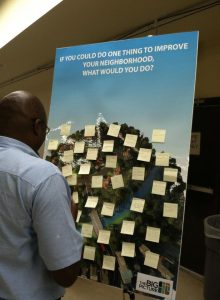 The resulting comprehensive plan guided land use, redevelopment, and public investment around resident-identified priorities. Community feedback directly shaped catalytic redevelopment projects: a vacant shopping center became a new career and technical academy; a declining regional mall gave way to Mid City, a thriving mixed-use district; and a historic gymnasium at a former high school was converted into a public recreation center. The city also added more than 30 miles of greenways, expanded parks, and built new recreation centers and public facilities, each shaped through public meetings to reflect neighborhood needs.
When the plan was presented to the Planning Commission in 2017, it was adopted unanimously with no public opposition, which is a testament to the trust built through the process. Residents can see clear connections between their input and outcomes, reinforcing ongoing engagement. As Huntsville approaches the plan’s ten-year anniversary, the city will launch renewed community engagement to guide the next decade of growth.
Building Civic Leaders: The Huntsville Civic Engagement Academy
A thriving democracy depends on an engaged citizenry, yet only 56% of U.S. adults consider themselves civically engaged. Huntsville created the Civic Engagement Academy (CEA) to demystify municipal government and empower residents to engage more deeply in civic life. Hosted by the Office of Multicultural Affairs, the program introduces residents to the inner workings of city government while creating meaningful pathways for participation. Huntsville residents from diverse backgrounds—more than 50% of graduates identify as Black, 20% come from low- to moderate-income households, and participants span multiple generations—learn directly from city leaders, helping residents see themselves as partners in shaping the city’s future.
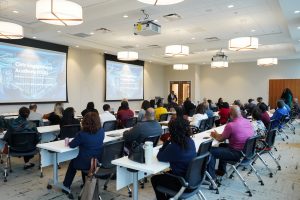
The Civic Engagement Academy offers a free, eight-week immersive program each spring and fall featuring weekly sessions with city departments, hands-on learning experiences, and direct dialogue with public officials. Participants explore city operations, infrastructure, public safety, planning, and community resources. Since its launch in 2022, more than 300 residents across seven cohorts have completed the program. Graduates are supported through an Alumni Association that provides ongoing engagement opportunities, including service projects, educational sessions, and connections to city initiatives.
Participants reported significant gains in their understanding of local government, awareness of community issues, and participation in civic activities, with self-reported civic engagement scores rising from 5.41 to 7.93 on a 10-point scale. Graduates have gone on to serve on boards, volunteer, and contribute to community initiatives. Huntsville plans to continue expanding the program’s reach, with a goal of cultivating more residents as active civic partners in the city’s continued growth.
Resident-Led Governance Through Huntsville’s Boards and Commissions System
Rapidly growing cities risk letting economic expansion outpace transparency and equitable decision-making. To keep residents central to governance, the Huntsville built an extensive network of more than 60 boards and commissions with over 360 resident members representing a diverse cross-section of the community. Open meetings, public comment opportunities, and appointments reflecting varied backgrounds ensure residents are not only informed but actively shaping Huntsville’s growth and priorities.
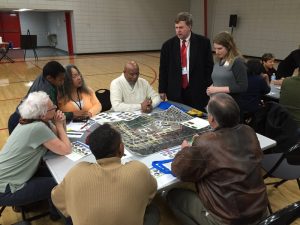 Huntsville’s boards and commissions address a wide range of civic priorities. The Planning Commission guides major development through transparent public review, including a $350 million Mill Creek Choice Neighborhood Initiative that will transform a historically underinvested area with 700+ housing units. Commissions focused on human relations, accessibility, and public safety strengthen trust and inclusion across the city. The Beautification Board recognized 347 properties in 2025 alone for environmental stewardship and community pride. Quasi-governmental boards overseeing utilities, land conservation, and behavioral health extend resident influence into institutions that touch everyday life.
The system has strengthened transparency, increased civic participation, and ensured community perspectives are embedded in decision-making. Regular public meetings across 60+ boards provide ongoing opportunities to influence housing, accessibility, neighborhood development, and public safety. Looking ahead, Huntsville plans to expand outreach to underrepresented communities, connect the Civic Engagement Academy to the boards pipeline, and leverage technology to make participation more accessible.
Some Related Posts
Thank You to Our Key Partners